I have written about Nigeria’s insecurity long enough to notice a pattern I could not quite name at first.
Some time ago, Rev. Fr. Prof. Akinwale wrote about bandits invading nine villages in Kaduna’s Giwa LGA while our politicians were busy holding party conventions.
In an earlier article, I mapped the violent states one by one, only to conclude that all of us have become sitting ducks. More recently, I questioned Operation Safe Corridor and asked why we rehabilitate killers before a single court has convicted them.
I had also asked what the President intends to do with the savings from a subsidy he removed and a loan he just signed, while Fulani militias run parallel governments in Zamfara, Katsina, Kaduna, Sokoto, Niger, Benue, Plateau and Taraba.
Each of these pieces was written as its own outrage. For a while, I took a break from writing about the woes of this country. But it was not a break that was meant to last.
For days now, I have followed reports about the Presidential Foreign Intervention Promotion Council (PFIPC) and its self-styled Director-General, Adeniyi Adeyemi Mathew, who allegedly used forged documents bearing the signature of Chief of Staff Femi Gbajabiamila to secure a ₦1.3 billion allocation in the 2026 national budget.
Then I read reports that kidnappers had abducted a corpse and nine mourners… At that moment, I realised these were not isolated tragedies. They were symptoms of state capture.
I reached this conclusion after reading the 2025 publication by International IDEA and the Constitution Transformation Network, State Capture: How to Recognize and React to It. It gave me the word I had been groping for.
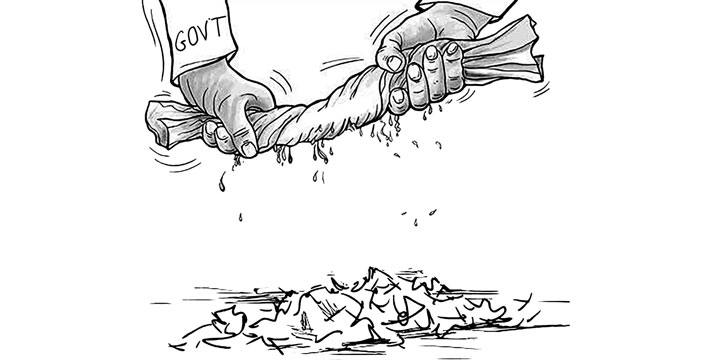
The report defines state capture as a situation where individuals or groups, called “captors,” gain enough influence over state institutions that those institutions stop serving the public and start serving private interests instead.
That definition helped me connect the dots between the many faces of banditry, mineral resource exploitation, our electoral crisis, and the politics of pardon into one coherent, diagnosable disease.
What is State Capture?
State capture, according to IDEA, is not one bribe or one scandal. It is the repurposing of state institutions—from the presidency and the legislature to the courts, the electoral commission and the security forces—so that they consistently work for a narrow set of interests rather than for the Nigerian people who fund them with their taxes and their blood.
These captors can be political and economic elites, family dynasties, criminal networks or foreign actors, and they rarely announce themselves. They hide behind things that sound reasonable. They make donations, appoint people into public offices, grant security contracts, and float amnesty programmes.
Perhaps the most important aspects of the IDEA report are its six recurring indicators of state capture. As I went through them, I realised that Nigeria is not merely showing signs of state capture; we are living inside nearly all of them.
- State Action That Contradicts the Public Interest: Banditry as a Business Model
IDEA’s first indicator is state institutions behaving in ways that go against the public interest while quietly benefiting private actors. Have we tried to profile who these terrorists are? Have we tried to find out where the billions of naira collected from ransoms across the country go?
Northern Nigeria’s banditry has grown into what one recent security analysis describes as a “quasi-corporate enterprise,” complete with its own revenue streams and arms pipelines. That is not an accident of weak government. Investigations have repeatedly linked the persistence of banditry to illegal gold and lithium mining networks involving politically connected Nigerians and foreign corporations, reportedly sponsoring armed groups to protect their mining interests and displace communities sitting on these mineral deposits.
One security source even claimed to possess “a list of names, from state governors down to political influencers,” allegedly on the payroll of bandit sponsorship networks. The 2021 Nextier data I cited some years ago already showed Zamfara, Kaduna and Borno bleeding hundreds of lives annually, while SBM Intelligence’s estimate of over six million small arms in civilian hands demonstrates that this was never a spontaneous crisis. Someone deliberately armed these bandits.
I have colleagues serving in Northern Nigeria who have told me how Fulani militias have become the de facto government of entire rural communities across Zamfara, Katsina, Kaduna, Sokoto, Niger, Benue, Plateau and Taraba—imposing taxes, seizing land, and telling farmers what they may or may not do. When an armed group can tax a population, regulate its movement and enforce its own rules more reliably than the Nigerian state, that is not just insecurity.
- Nepotism and Elite Capture of Public Institutions
IDEA identifies nepotism as another indicator of state capture, where elite families and networks retain key state positions to serve their own interests.
A colleague of mine, Fr. Israel Answeokhai, once observed that Nigeria’s own version of this played out in the NDDC saga he wrote about in 2020. A commission established to develop the oil-rich Niger Delta instead became a place where, as he put it, “every politics is local… not for the good of the locals, but for selfish interests.” Billions were allegedly diverted while the very region it was created to serve remained underdeveloped, and a minister and a sacked managing director traded public, damning allegations before a probe panel that itself struggled to appear impartial.
That is the pattern that keeps repeating in this country. An institution is created for the public good, and within a few years, it becomes patronage machinery for whoever controls its appointments. We do not lack institutions in Nigeria. We lack institutions that have not yet been colonised by someone’s interests.
- Electoral Capture: INEC Under Pressure
IDEA’s third indicator—the erosion of independent oversight bodies—is perhaps most visible today in the Independent National Electoral Commission (INEC). Academic analyses of the 2023 general election found that despite reforms intended to strengthen INEC’s independence, the commission’s operations remained heavily shaped by political interference, corruption and weak rule enforcement.
There were allegations of officials accepting bribes from politicians to manipulate electoral outcomes. Ahead of the 2027 elections, watchdog groups have warned that INEC’s leadership transition risks becoming, in their words, a moment of “institutional capture by political forces.” The appointment of the current INEC chairman was itself criticised by civil society groups as being driven more by political loyalty than competence.
Add to this the pattern identified by election integrity analysts: governors defecting en masse to the ruling party, opposition structures being absorbed rather than defeated, and the National Assembly weakening real-time result transmission safeguards despite civil society objections. Together, they present exactly the picture the IDEA report warns about.
- Judicial and Institutional Pressure
Recent controversy in Nigeria over housing benefits reportedly extended to judges by a politically connected federal administrator raises exactly the concern the IDEA report anticipates. How can the same political establishment that benefits from court rulings also be seen to be materially rewarding the judiciary?
What happens to state authority when a controversial cleric like Ahmad Gumi can speak publicly for and to armed bandits, seemingly without consequence, while ordinary Nigerians calling for accountability are picked up one after another by the DSS?
- Operation Safe Corridor: Mercy, Impunity, or Something Else?
The IDEA report notes that state capture can involve institutions acting against the public interest while disguising their actions under terms such as rehabilitation, forgiveness and national healing.
I have already asked, in an earlier piece on Operation Safe Corridor, whether the conversation around admitting “repentant” Boko Haram members back into society is really about the common good or about securing more funding for a military operation that experience has shown to be ineffective.
Mercy has its place. Rehabilitation has its place. But justice cannot become optional simply because the crimes are politically inconvenient. When those who have buried loved ones are asked to welcome back men who have never stood trial, the burden of reconciliation is placed almost entirely on victims rather than on perpetrators.
That is precisely the kind of inversion of the public interest the IDEA report warns against.
- Manipulative and Transnational Influence
Chinese nationals and companies have repeatedly been implicated—though they deny involvement—in illegal mining networks that reportedly fund armed groups in Nigeria’s North-West. The U.S. Treasury’s 2026 sanctions on Nigerian individuals and bureaux de change allegedly linked to ISIS financing point to the same transnational dimension of state capture that the IDEA report identifies.
State capture is rarely a purely domestic affair. Where valuable natural resources, weak institutions and international commercial interests converge, foreign actors often become willing participants, beneficiaries or enablers. Nigeria’s experience increasingly reflects that reality.
So, Is the Nigerian State “Captured”?
In my opinion, Yes. But we can still do something about it. The IDEA report is careful to note that state capture is rarely total. Institutions are usually captured “completely or in part,” and different institutions are compromised to different degrees. That distinction matters.
Nigeria still has a free press, an active civil society, and priests, pastors and imams who refuse to keep quiet. There are still citizens willing to protest and litigate even when doing so comes at great personal cost.
The IDEA report does not end with diagnosis. It points to what can be done.
- Active citizenship: Using the vote, yes, but also refusing to go quiet between elections, as I have consistently insisted by asking where the ransom money and the subsidy savings actually go.
- Civil society vigilance: The kind of monitoring Yiaga Africa, CDD West Africa and researchers at Newcastle University are already undertaking around INEC’s preparations for 2027 and the outcomes of Operation Safe Corridor.
- Transparency: Demanding published beneficial ownership of mining licences, traceable mineral exports, and the identification of those sponsoring armed groups.
- Institutional vigilance: Remembering, as the report warns, that even institutions created to resist capture—electoral commissions, anti-corruption agencies and deradicalisation programmes—are themselves prime targets for capture and therefore require constant public scrutiny.
None of this is a quick fix, and I will not pretend otherwise. But recognising banditry, electoral interference and the politics of pardon as symptoms of one underlying disease rather than unrelated crises is the first step the IDEA report recommends, and the first step I am taking with this piece.
Nigeria does not merely have a security problem, a corruption problem or an election problem. Nigeria has a state capture problem. The only remaining question is: What are we going to do about it?
About the Author