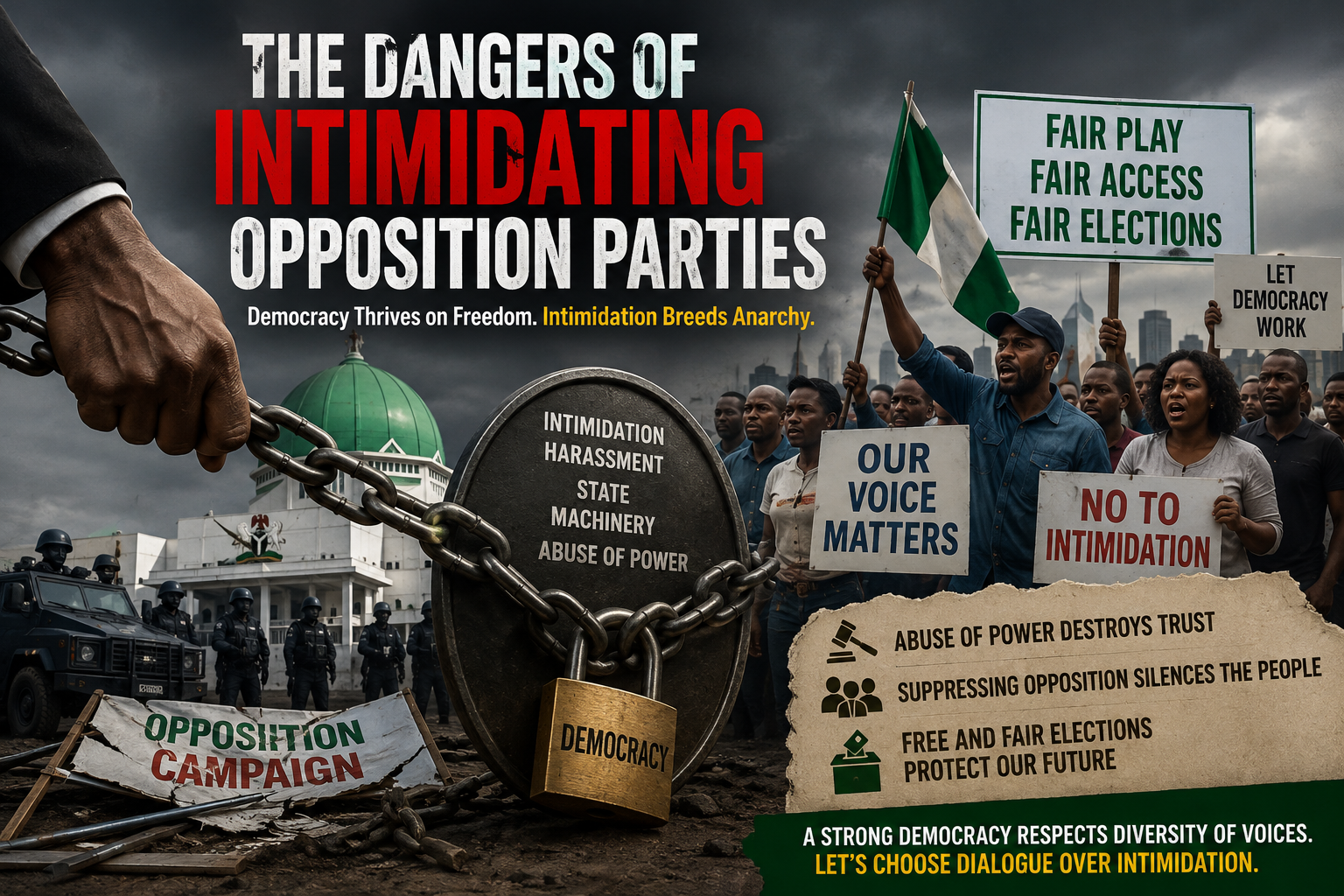
Democracy cannot survive where political competition is treated as a crime. In any democratic society, opposition parties and political figures have a legitimate role to play. They are not enemies of the state. They are an essential part of the democratic process, providing alternative ideas, challenging government policies and giving citizens meaningful choices at the ballot box.
Yet, concerns are increasingly being raised about the treatment of opposition parties and political actors under the APC led government. Across the country, allegations of intimidation, harassment and the use of state institutions against political opponents continue to fuel public anxiety. From the destruction or removal of campaign billboards to difficulties securing venues for political activities, the political environment appears increasingly hostile to those outside the ruling establishment.
More troubling are allegations that government agencies are sometimes used selectively against opposition figures. Anti graft institutions have an important constitutional responsibility to investigate corruption and protect public resources. But when investigations and prosecutions are perceived as politically motivated or selectively targeted, public confidence in these institutions suffers.
The issue is not whether anyone should be above the law. Nobody should be. If an opposition politician commits a crime, the appropriate institutions should investigate and prosecute according to the law. But the same standards must apply to everyone, regardless of political affiliation. Justice must not only be done. It must also be seen to be impartial.
The destruction of opposition campaign materials or the denial of legitimate access to public spaces may appear insignificant to those in power. In reality, such actions can have serious consequences. Elections are supposed to be contests of ideas, policies and competence. When one side uses the advantages of incumbency to restrict the visibility and activities of its competitors, the credibility of the entire electoral process becomes questionable.
A democracy without a strong opposition is dangerously close to becoming a political monopoly. When citizens begin to believe that their preferred candidates cannot compete fairly, political apathy can grow. Voters may lose interest in elections, believing that the outcome has already been determined.
That is a dangerous path for any nation.
Nigeria has experienced enough political tension, distrust and violence. Political leaders must therefore understand that victory at the polls should never come at the expense of national stability. The ruling party has a responsibility to protect democratic space even for those seeking to defeat it.
Opposition parties also have a responsibility to remain peaceful, organized and committed to the rule of law. They must document abuses, challenge unlawful actions through legitimate institutions and continue engaging citizens rather than allowing frustration to turn into violence.
The Independent National Electoral Commission, security agencies, courts and other institutions must equally demonstrate independence and fairness. Every political party should be allowed reasonable space to campaign, mobilize supporters and present its message to the electorate.
The 2027 general elections should not become a contest between the power of incumbency and the power of intimidation. They should be a contest between ideas and visions for Nigeria.
Those in power today will not remain in power forever. Political positions are temporary, but the institutions and democratic culture we build will remain.
The greatest danger is not merely intimidating an opposition party. The greater danger is creating a political environment where citizens lose faith in democracy itself.
Nigeria cannot afford that.
About the Author