The Last Sunday in Ordinary Time, Year A. Solemnity of Christ the Universal King. Ez. 34:11-12, 15-17; Ps. 23:1-3, 5-6; 1 Cor. 15:20-26, 28; Matt. 25:31-46.
Did you know that this earth of ours is a tiny planet in the Universe? Did you also know that our Sun, that big bright ball of light is one tiny star in a Galaxy that has hundreds of billions of stars? Did you also know that the observable universe has hundreds of billions of galaxies?
As I wrote this homily, I took the time to reflect on and research the meaning of the word “Universe”. I understand that we believe we know what it means. But do we? Really?
So trust me when I say that we can never know nor fully understand the meaning of the word Universe. Awed by the sheer grandeur of God’s creation, the Psalmist says, “when I see the heavens, the work of your hands, the moon and the stars which you arranged, what is man that you should keep him in mind? Mortal man that you care for him? (Ps. 8:3-4).
Now, dear friends, think about the UNIVERSE for a moment.
Think about our planet Earth, with all its nations, with all its kingdoms. Think about the various governments, presidents, kings, queens, and understand that Jesus Christ is KING of them all.
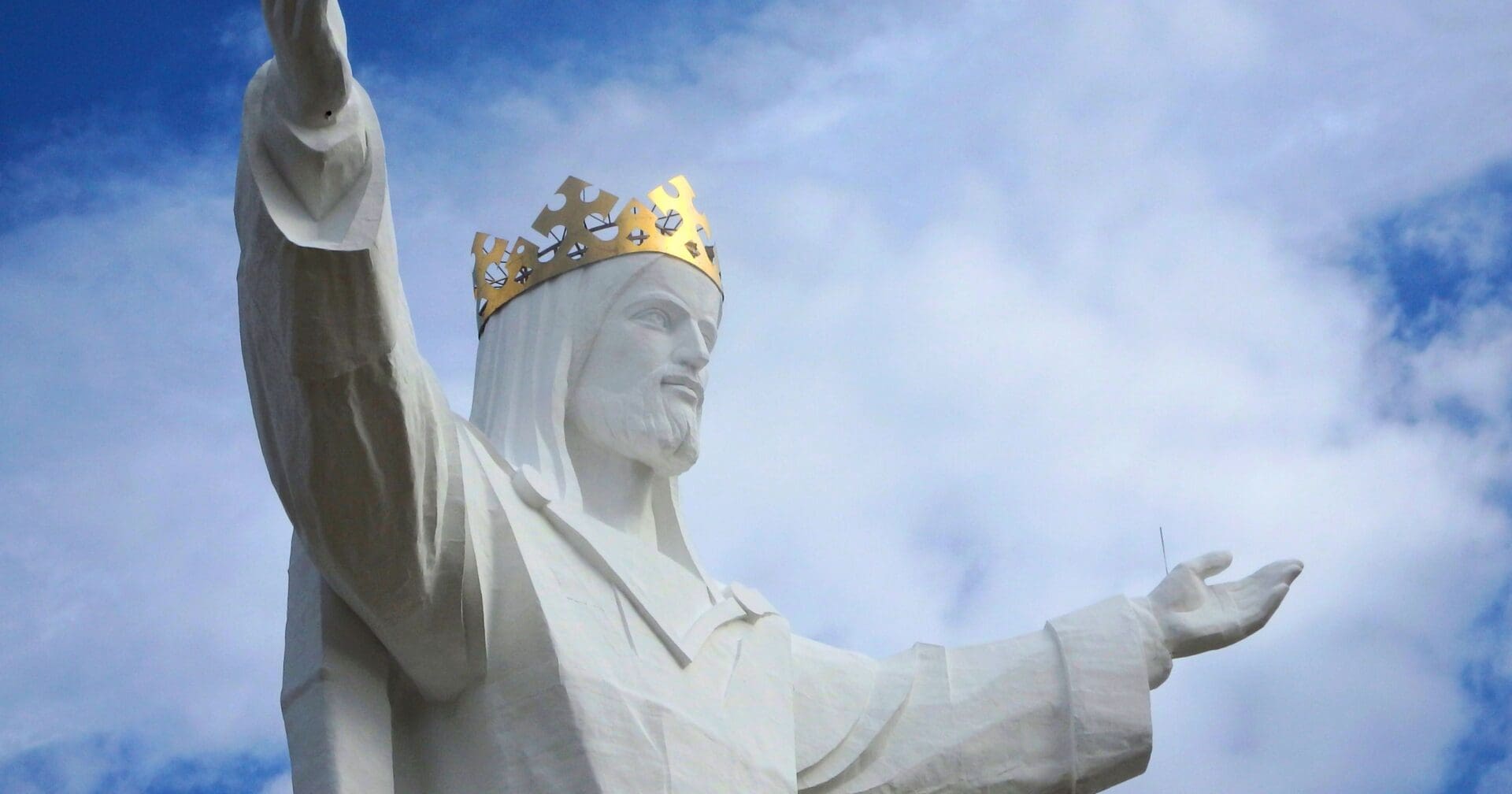
This is what we mean when we celebrate Christ the Universal King. He is not simply the King of Christians, the King of Catholics, or the King of those who acknowledge his authority. He is the King of all creation. His kingship is not restricted by geographical boundaries, political territories, or even the limits of the universe as we know it.
Today’s Solemnity was instituted by Pope Pius XI in 1925 with his encyclical Quas primas (“In the first”) to respond to growing secularism and hostility against the Church.
It was instituted at a time when the world was still recovering from the First World War. A time when various political ideologies were increasingly challenging the place of religion in public life. Pope Pius XI wanted to remind the world that human authority, however powerful, is never absolute.
This encyclical letter of Pope Pius XI gave Catholics at that time much hope, assuring them that Jesus Christ reigns above all earthly rulers. So while temporal powers will certainly fade away, the reign of Christ and His kingdom remain forever.
The implication is that no government, no political authority, and indeed no individual can legitimately exercise power without regard for the dignity of the human person and the moral authority of God.
Unfortunately, this is something we so often forget, especially in our exercise of power. We sometimes become so intoxicated by power that we begin to behave as though our positions will last forever. Don’t we see this pattern in politics, in our workplaces, in our communities, and sometimes even in our families?
Dear friends, today’s second reading reminds us that Christ continues to be King until all authorities and powers are put under his feet, including death.
Here, St Paul teaches us that Christ has been raised from the dead as the first fruits of those who have fallen asleep. Just as death came through Adam, so life comes through Christ. And the last enemy to be destroyed is death itself.
But this King whose authority extends over the entire universe is not presented to us in today’s first reading as a distant, unapproachable ruler. He is one who goes out of his way to gently shepherd us, personally seeking the lost, bringing back the stray, bandaging the wounded and making the weak strong.
Through the Prophet Ezekiel, God describes Himself as a shepherd who personally cares for his flock. He searches for those who have wandered away, rescues those who are scattered, and attends to the needs of the wounded and the weak.
So while kingship in our world is understood in terms of power and political influence, the Kingship of Jesus Christ is seen in selfless and unconditional service. And this is an important lesson for those of us who exercise authority in one capacity or another, especially in the Church.
Dear friends, by virtue of our baptism, we all share in the kingly office of Jesus Christ. We too are therefore called to show leadership and good example to those who look up to us in whatever circumstances.
Do we use our positions to make life easier for those entrusted to our care, or do we take advantage of their vulnerability?
Do we look for opportunities to serve, or do we expect others to serve us simply because we occupy certain positions?
The basic question therefore revolves around how we treat one another.
In our Gospel reading, from Matthew 25:32-46, we encounter one of the most striking descriptions of the final judgement in the whole of Scripture.
Jesus presents himself as the Son of Man who comes in glory, accompanied by his angels. All the nations are gathered before him, and he separates them as a shepherd separates sheep from goats.
Those on his right are invited to inherit the kingdom prepared for them, while those on his left are condemned.
But what is particularly interesting is the basis of this judgement.
William Barclay, in his commentary on this passage, reminds us that God will judge us in accordance with our reaction to human need. Again, how we treat one another.
Friends, we will not be judged on account of the knowledge we have accumulated, the fame we have acquired, or the fortune we have gained. We will be judged based on the assistance we rendered.
This does not mean that faith, prayer, worship and the sacraments are unimportant. Rather, it reminds us that genuine faith must necessarily find expression in love.
And there are three important lessons about the kind of help that Christ expects us to give:
The first is that our help must be given in simple things.
Notice the examples Jesus gives in today’s Gospel.
Feeding the hungry, giving water to the thirsty, welcoming the stranger, clothing the naked, visiting the sick and the imprisoned.
These are ordinary acts of kindness that are within the reach of almost everyone.
Jesus does not say that we must become millionaires before we can be charitable. Neither does he say that we must establish enormous charitable organisations before we can make a difference in the lives of others.
Sometimes, what another person needs is simply a meal, a little encouragement, a listening ear, or someone willing to visit when everyone else has forgotten them.
Think about the people we encounter every day.
That elderly neighbour who lives alone and rarely receives visitors. That struggling family whose children sometimes go to bed hungry. That sick parishioner who has spent several weeks in hospital without anyone checking on him.
Or that young person who is gradually losing hope because nobody seems interested in listening to what he or she is going through.
The second lesson is that our help must be uncalculating.
In today’s Gospel, those who are welcomed into the kingdom appear genuinely surprised when Jesus tells them that they had fed him, clothed him and visited him.
They ask, “Lord, when did we see you hungry and feed you, or thirsty and give you drink?”
They had no idea that they were serving Christ!
And that is precisely what makes their generosity so remarkable.
They did not help because they expected recognition. They were not calculating how much heavenly reward they would receive. They simply encountered people in need and responded with compassion.
Compare this with what sometimes happens in our society today.
There are people who cannot offer assistance without making a public announcement. Some cannot make donations without ensuring that their names are mentioned. Others appear more interested in documenting their charitable activities than in preserving the dignity of those they claim to be helping.
And with the growing influence of social media, the temptation to turn charity into publicity has become even greater.
Now, there is nothing inherently wrong with publicising charitable activities. Sometimes, doing so can encourage others to give, promote accountability, or draw attention to the plight of vulnerable people.
But we must constantly ask ourselves, “are we helping because someone needs help, or because we want people to see us helping?
If there were no cameras, no photographs, no Facebook posts, no public appreciation, and no applause, would we still be willing to help?
The third lesson is that whatever help we give to others, we give to Christ himself. And whatever help we refuse to give, we refuse to Christ.
Jesus says, “As you did it to one of the least of these my brethren, you did it to me.”
The King of the universe identifies himself so closely with those in need that whatever is done for them is done for him.
Here in Nigeria, the celebration of the Solemnity of Christ the King is often marked by a Corpus Christi procession.
This procession typically involves carrying the Blessed Sacrament in a monstrance, while the faithful follow in prayer and adoration. In Nigeria, we do a lot of praying, and a lot of dancing.
Although the Solemnity of the Body and Blood of Christ is celebrated each year, on the Thursday or Sunday after Trinity Sunday, its procession does not ordinarily occur in many parts of Nigeria until the Solemnity of Christ the King, due to weather conditions, since it is much drier in November than in the earlier months of the year.
Today’s procession is a beautiful public expression of our Faith. We will again carry the Blessed Sacrament through our streets, singing hymns, praying and publicly proclaiming that Jesus Christ is KING.
As we do this, let us recall that we cannot genuinely honour Christ in the Eucharist while deliberately neglecting the needs of those with whom he identifies himself.
We cannot kneel in adoration before Christ in the monstrance and then treat the poor, the weak and the vulnerable with contempt.
Indeed, the more sincerely we adore Christ in the Eucharist, the more sensitive we ought to become to the suffering of others.
May Christ continue to reign in our hearts and in our lives, Amen.
God bless you.
About The Author