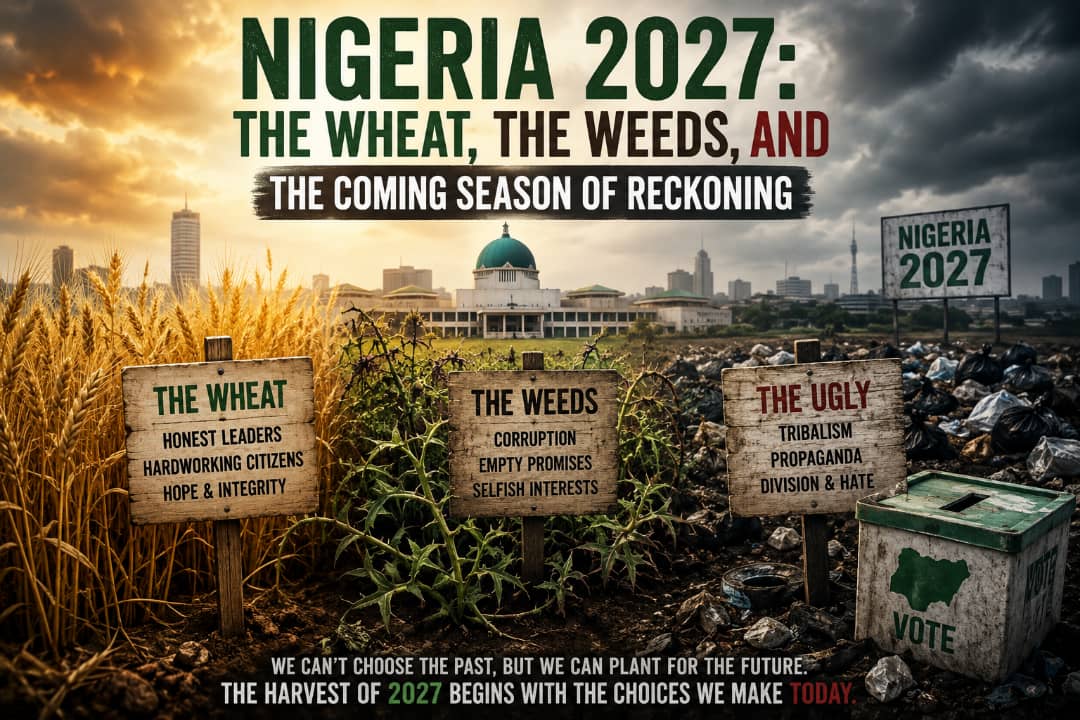
In today’s reflection on Matthew 13:36–43, Jesus explains the parable of the wheat and the weeds. The lesson is simple but profound: until harvest time, the good and the bad often grow side by side. Looking at Nigeria as we move toward the 2027 general elections, a season many are already calling a year of reckoning-:one cannot help but see how closely our national life mirrors that parable, with an added layer of complexity: the confusion, the fatigue, and the growing impatience of a people stretched thin.
Nigeria is still blessed with brilliant minds, hardworking citizens, honest public servants, and courageous young people who refuse to surrender hope. These are the wheat. Quietly, they keep the nation standing despite every reason to give up. They pay taxes, build businesses, educate children, and still find ways to laugh through hardship. If resilience were a national currency, Nigeria would be among the richest countries in the world.
Then there are the weeds.
These are the politicians who only remember the people when election season approaches. As 2027 draws nearer, promises are already being repackaged, slogans refreshed, and old failures dressed in new language. Roads become talking points, poverty becomes campaign material, and public trust is once again treated as something to be harvested rather than earned. Public service, in many cases, has become a revolving door where power is pursued more for privilege than for purpose.
And then… there is the ugly.
The ugly is the deepening politics of division, propaganda, and selective truth. It is the normalization of hardship, the constant shifting of blame, and the growing attempt to convince citizens that survival is success. Inflation bites harder, insecurity persists, unemployment weighs heavily on the youth, yet political communication often sounds detached from lived reality. If denial alone could fix a nation, Nigeria would have been transformed many times over.
The beauty of Christ’s parable is that the servants were instructed not to uproot the weeds prematurely lest they destroy the wheat as well. That remains a sobering lesson for Nigeria as 2027 approaches. In our frustration, we must resist the temptation to conclude that all leaders are the same or that every institution is beyond repair. There are still men and women of integrity serving quietly, often without noise, recognition, or political protection.
However, the parable also carries a warning. Harvest eventually comes. And in democratic terms, elections are one of those harvest seasons. 2027 will not just be another cycle of voting, it will be a moment of reckoning. Accountability may be delayed, but it is never erased. Every promise made, every policy implemented, every opportunity wasted, and every act of genuine service will eventually meet the judgment of the people.
Nigeria’s greatest challenge is not merely the existence of weeds. Every nation has them. The real danger is when the weeds begin to define the field, set the tone of leadership, and shape the expectations of the wheat. Even more dangerous is when the wheat begins to lose faith in the possibility of change.
Perhaps this is the time for citizens to become more intentional gardeners of democracy. 2027 will demand more than slogans and sentiment. It will require informed voters, courageous conversations, and leaders who understand that power is temporary but consequences are lasting.
Until then, the wheat, the weeds, and the ugly will continue to share the same field. But the comfort in the parable remains: harvest season always arrives. And when it does: especially in a year like 2027…what will matter most is no longer appearance, but accountability, character, and the true weight of leadership.
About the Author