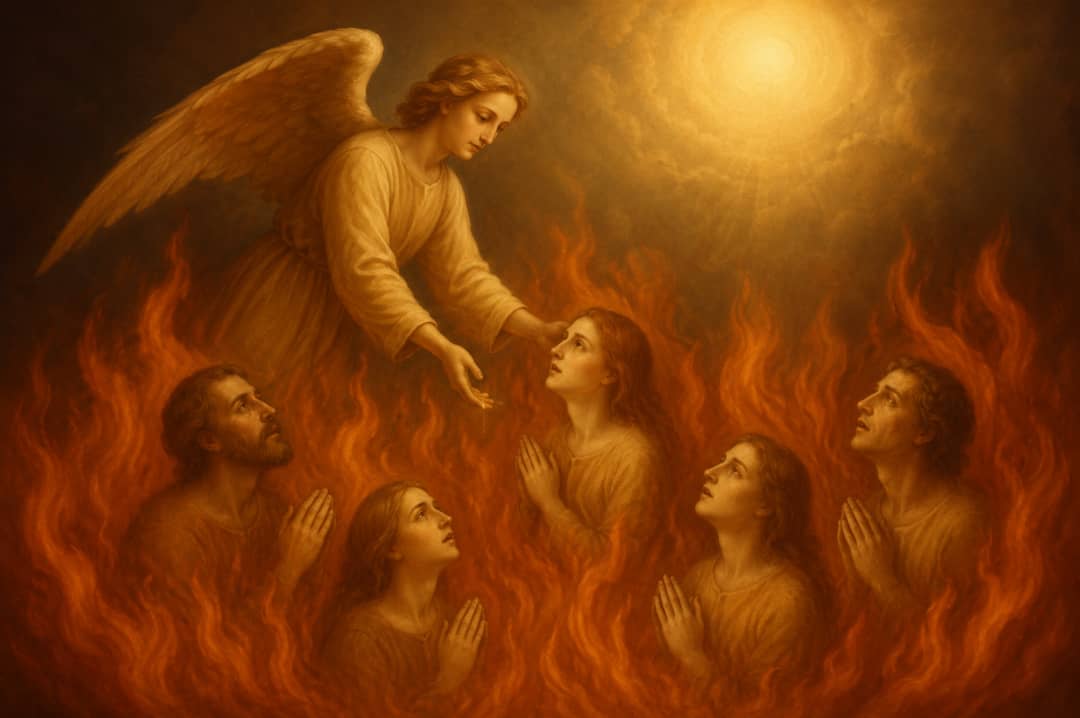
Few Catholic teachings are as misunderstood as the doctrine of Purgatory. Some imagine it as a second chance to repent after death or a place where souls earn their way into heaven. The Catholic Church teaches neither.
Purgatory is the final purification of those who die in friendship with God but still carry the lingering effects of sin. It is not a rival to Christ’s saving work but a continuation of it.
The Catechism of the Catholic Church teaches that those who die in God’s grace, though imperfectly purified, are assured of salvation. Before entering the fullness of heaven, however, they undergo a final purification.
Every person’s eternal destiny is sealed at death. Purgatory does not change that destiny. Rather, it prepares the saved soul for the perfect holiness required to stand before God, for Scripture teaches that nothing unclean can enter heaven.
Most believers die loving God but still struggling with imperfections or the temporal effects of forgiven sins. In his mercy, God completes in them the work of sanctification that began during earthly life.
Although the word Purgatory does not appear in the Bible, neither do terms like Trinity or Incarnation. These doctrines are accepted because they arise from the whole witness of Sacred Scripture and Sacred Tradition.
One important biblical foundation is found in 2 Maccabees 12:44–46, where Judas Maccabeus offers sacrifices for fallen soldiers so they “might be delivered from their sin.” Such prayers only make sense if some purification remains possible after death.
Another key passage is 1 Corinthians 3:13–15, where St. Paul says a person’s works will be tested by fire. He explains that the person “will be saved, but only as through fire.” The individual is saved—not condemned—but purified.
St. Thomas Aquinas understood this fire as an image of God’s purifying love, cleansing the soul and preparing it for perfect union with Him.
Jesus also speaks of sins that “will not be forgiven, either in this age or in the age to come” (Matthew 12:32). Many of the early Church Fathers understood this to imply that some sins can indeed be forgiven after death.
Throughout Scripture, God calls His people to complete holiness. Jesus commands, “Be perfect, as your heavenly Father is perfect,” while Hebrews reminds believers to pursue “the holiness without which no one will see the Lord.”
Sacred Tradition strengthens this biblical foundation. St. Paul urged Christians to hold firmly to the traditions handed on “by word of mouth or by letter.”
From the earliest centuries, Christians prayed for the dead. Inscriptions in the Roman catacombs contain prayers asking God to grant peace and mercy to departed believers—prayers that would be unnecessary if no purification after death existed.
The early Church Fathers affirmed this belief. St. Augustine wrote of souls purified by a cleansing fire before entering heaven. St. Gregory the Great encouraged prayers and Masses for the faithful departed.
Centuries later, St. Thomas Aquinas brought together the Church’s teaching with remarkable clarity. Christ alone saves; Purgatory simply applies His saving grace. The souls in Purgatory are certain of heaven, experiencing not despair but loving longing for God.
During the Middle Ages, theologians gave more precise language to this ancient belief. As historian Jacques Le Goff explains, the doctrine developed in expression without changing its essential meaning.
At the same time, the understanding of the Communion of Saints became clearer. The Church Militant on earth, the Church Suffering in Purgatory, and the Church Triumphant in heaven remain united in Christ.
When the Protestant Reformation challenged the doctrine, the Council of Trent reaffirmed the Church’s teaching. It declared that Purgatory is real, that prayers and Masses benefit the faithful departed, and it also corrected abuses associated with indulgences.
Today, the Catechism of the Catholic Church summarizes this teaching beautifully. Souls needing purification undergo it before entering heaven (CCC 1030). The Church calls this purification Purgatory (CCC 1031). From the earliest times, Christians have honored the dead through prayer and the Eucharistic sacrifice (CCC 1032).
Properly understood, Purgatory is not a sign of God’s harshness but of His compassion. Pope Benedict XVI described it as the burning away of everything within us that is incompatible with heaven.
It is Christ completing His work in the soul, fulfilling St. Paul’s promise that “he who began a good work in you will bring it to completion.”
For Catholics today, the doctrine is not merely something to understand but something to live. It calls us to pursue holiness now, receive the sacraments faithfully, pray for the dead, offer Masses for departed loved ones, and trust completely in God’s mercy.
Purgatory is not a second chance after death. It is love’s final purification, preparing the redeemed soul to behold God forever in perfect holiness and everlasting joy.
About the Author