Background
Recently, social media came alive with the appeal letter written to the Priestly Fraternity of St Pius X (SSPX) by Pope Leo XIV. In that letter, which was addressed to the Superior General of the Society, the Reverend Davide Pagliarani, the Pope pleaded, saying:
“…I plead with you and ask you with all my heart: please turn back! I urge you to consider carefully the spiritual good of the faithful, because the schismatic act you are about to undertake would deprive them of the licit and, in some cases, even valid reception of the Sacraments, which they love and seek for their sanctification.”
Pope Leo went on to conclude the letter in these words:
“With a sorrowful yet hopeful heart, I feel it is my duty, through the authority received from Christ, to ask you to desist from your intended act. I entrust these intentions to the Immaculate Heart of Mary, Mother of Good Counsel.”
Not long after, the Superior General responded. He began by saying,
“For a long time, I had hoped to have the opportunity of meeting You in person, in order to express to You directly our sincere desire to serve the Church. Unfortunately, that opportunity has not presented itself.” Among other things, he added:
“Far be it from us to separate ourselves from the Roman Church. We desire, on the contrary, to serve her by means that are extraordinary, as one would assist a mother in distress who requires particular help, even if such help is not understood by everyone.”
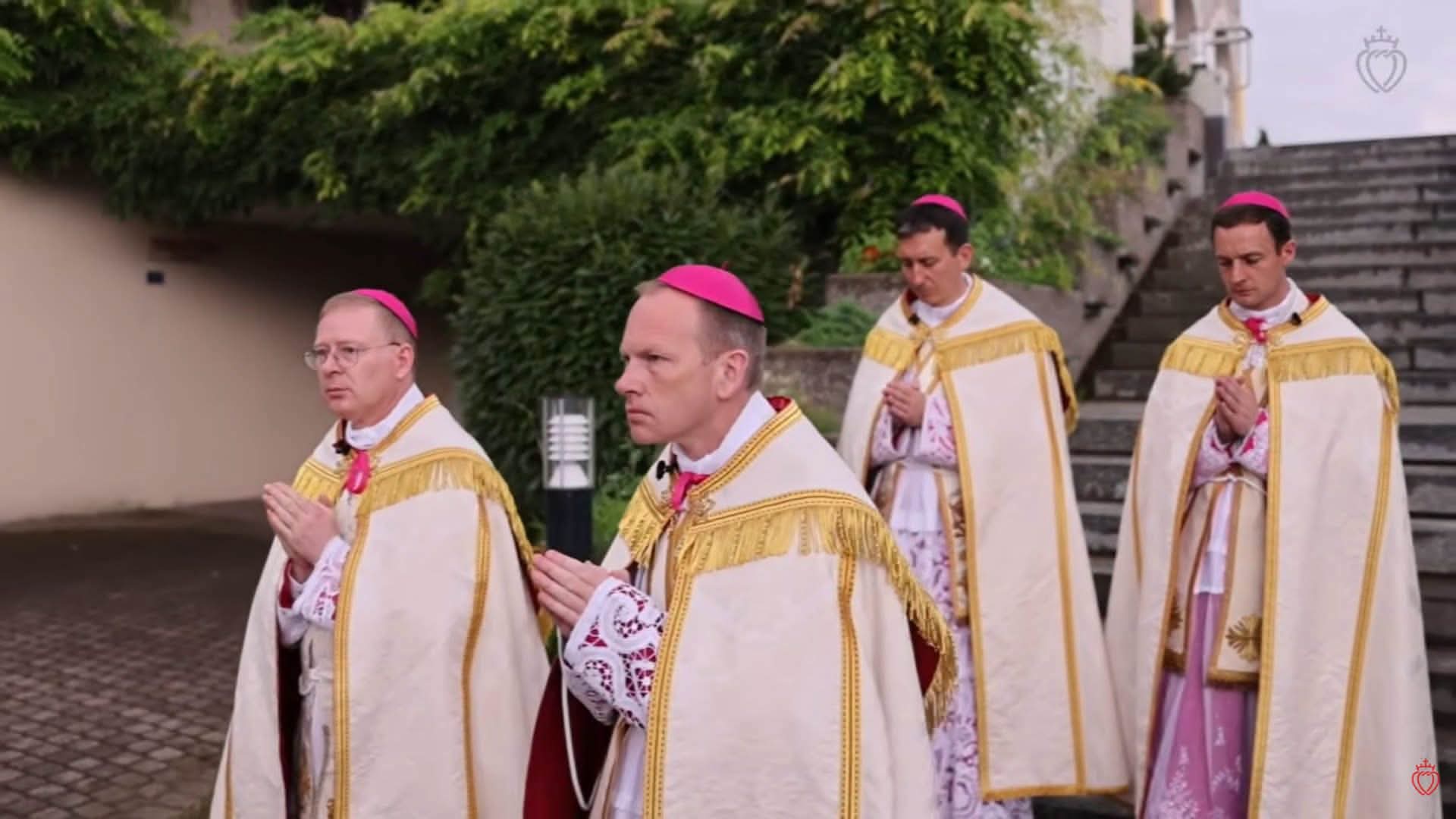
To cut the long story short, after imploring the Holy Father’s understanding, and expressing hopes that “One day, all the difficulties between the Holy See and the Society will be resolved”, the Society went on to carry out the illicit ordination of Bishops, without the approval of the Pope. Strange, right?
From his response to the Holy Father, it does seem that the Rev Davide Pagliarani, and indeed the Priestly Fraternity of St Pius X, considers the entire Catholic Church to be in distress. They are convinced that only they can provide the “particular help” that the Catholic Church needs, “even if such help is not understood by everyone.” This sums up their decision to go ahead with the illicit ordination of Bishops for the Society. An explanation I find quite unsettling.
Excommunication
In the wake of the ordination, the Dicastery for the Doctrine of the Faith declared that “such disobedience—which implies in practice the rejection of the Roman primacy—constitutes a schismatic act” (cf. John Paul II, Apostolic Letter Ecclesia Dei, 3).” The DDF added that “the sacred ministers belonging to the Priestly Fraternity of Saint Pius X are in schism and must therefore be considered schismatics.”
The DDF then concluded in these words; “as regards the lay faithful, those who formally adhere to the Priestly Fraternity of Saint Pius X are to be considered schismatics and excommunicated…” What this means is that the ministers of the SSPX, by carrying out acts in direct disobedience of the Holy Father, and the faithful of the SSPX by formally adhering to these acts of disobedience which incurred the Latae Sententiae.
Under Canon Law, any bishop who consecrates another bishop without a papal mandate, and anyone who receives such a consecration, automatically incurs the Latae Sententiae penalty the moment the act is completed. It is a severe form of excommunication in which the penalty can only be lifted or formally forgiven by the Vatican itself, following contrition and a request for reconciliation.
Lessons from History
Recall, that this is not the first time this has happened. The SSPX was founded in 1970 by Archbishop Marcel Lefebvre, a traditionalist who rejected Vatican II reforms, especially the move from Latin to vernacular liturgy. Conflict with Rome escalated over the years: the Vatican withdrew approval of the society in 1975, and in 1976 Pope Paul VI suspended Lefebvre, barring him from priestly and episcopal functions. In open disobedience, he continued regardless, expanding the society internationally.
Negotiations to prevent a formal split failed, and on June 30, 1988, Lefebvre consecrated four bishops without papal approval, resulting in automatic excommunication for him and the four bishops and cementing the schism. Those 1988 excommunications were later lifted by Pope Benedict XVI in 2009 to encourage dialogue, but the society never officially received legal status in the Church.
In 2016, as part of the Jubilee Year of Mercy, Pope Francis made further concessions to the society, approving a special provision that allowed SSPX priests to validly absolve sins heard during the sacrament of reconciliation; a provision that he later extended beyond the Jubilee Year.
In 2017, Pope Francis again approved another provision that guaranteed the validity of marriages celebrated by SSPX priests in traditionalist churches, under the condition that a canonically regular bishop had authorised the SSPX priest with the ability to witness or officiate the ceremony. In spite of these concessions, one wonders why the SSPX would choose to ignore history and go down the same path that led to the schism to begin with.
Responding to the claims of the SSPX
Nontheless, there are those who sympathise with the SSPX. They argue that a Church that is interested in unity must first show that interest within her ranks before preaching same. They further argue that the only wrongdoing attributed to the SSPX is their insistence on the traditional mass and their rejection of some wrong interpretations of the documents of the Vatican Council II. They’re mostly wrong.
And this is where it gets interesting. Many of those arguing for the SSPX have little or no idea what they actually claim. In his May 24, 1976 Speech at the Consistory for the creation of twenty new Cardinals, Pope Paul VI, mentions the major claims of the SSPX. Among other things, he says; “On the one hand, there are those who, under the pretext of greater fidelity to the Church and the Magisterium, systematically reject the teachings of the Council itself, its application and the reforms resulting from it, its gradual implementation by the Apostolic See and the Episcopal Conferences, under our authority, as willed by Christ.”
It is clear from the tone of this speech that Pope Paul VI is deeply pained by the claims of the founder of the SSPX. He adds:
“The authority of the Church is discredited in the name of a Tradition for which respect is only materially and verbally attested; the faithful are distanced from the bonds of obedience to the See of Peter and to their legitimate Bishops; the authority of today is rejected in the name of that of yesterday. And the fact is all the more serious since the opposition we speak of is not only encouraged by some priests, but is led by a Bishop, nevertheless always venerated by Us, Archbishop Marcel Lefebvre.”
Commenting on the attitude of the SSPX, the Pope added:
“They dare to assert that the Second Vatican Council is not binding; that the faith is also in danger because of post-conciliar reforms and orientations; that one has a duty to disobey in order to preserve certain traditions. Which traditions? It is this group, and not the Pope, not the College of Bishops, not the Ecumenical Council, that establishes which of the innumerable traditions are to be considered the norm of faith!”
One must pause at this point to reflect with Pope Paul VI. How does one group, conveniently outside obedience, dare to dictate that which is true tradition? What is it about the way the Mass is celebrated post Vatican II that made Lefebvre refer to it as a “bastard rite?” What was so evil about allowing vernacular languages in celebrating the Mass? The questions are endless.
But Pope Paul already provides these answers in the same 1976 Speech. He says:
“The adoption of the new ‘Ordo Missae’ is certainly not left to the discretion of priests or the faithful… The new Ordo was promulgated to replace the old, after careful deliberation, following the requests of the Second Vatican Council. In the same way, our holy Predecessor Pius V had made the Missal reformed under his authority obligatory, following the Council of Trent.”
Before turning his attention to those who deliberately and intentionally bring in their own idealogies, under the guise of Vatican II, Pope Paul VI makes an appeal to the SSPX saying:
“It is with profound sadness but with paternal hope that we turn once again to our Brother Monsignor Marcel Lefebvre and to his collaborators; we invite them to consider Christ’s grave warnings regarding the unity of the Church (cf. Jn 17:21 ff.) and the obedience due to the legitimate Shepherd whom He has placed over the universal flock, as a sign of the obedience due to the Father and the Son (cf. Lk 10:16 ). We await them with open hearts, with arms ready to embrace: may they know how to rediscover, in humility and edification, for the joy of the People of God, the path of unity and love!”
The SSPX has not been without its own squabbles. Many factions have ceded from the main SSPX, like the SSPX resistance, Society of St. Pius V, the Institute of the Mother of Good Counsel, the Company of Jesus and Mary, and the Sons of the Most Holy Redeemer. Other groups which ceded from the SSPX, but now reconciled with Rome include, Priestly Fraternity of St. Peter (FSSP) and Institute of the Good Shepherd (IBP).
As I pen these words, the Dicastery for the Doctrine of the Faith (DDF) has published guidelines outlining the procedures for SSPX priests and faithful seeking to reconcile with Rome. The door is always open for those who seek genuine paths of reconciliation. And the Church did not excommunicate anyone. They excommunicated themselves by their actions.
In conclusion, I ask again, “why would the SSPX choose to go down the same path that brought this much pain to the Church the first time?”
© Oselumhense Anetor, 2026.
#fadakaymedia
About the Author