Many people read the Bible without asking an important question. Who gave the world the Bible? The answer is found in history. The Bible did not fall from heaven as a complete book. It came through the Church that Jesus Christ established. That is why Catholics confidently say that the Bible is a Catholic book.
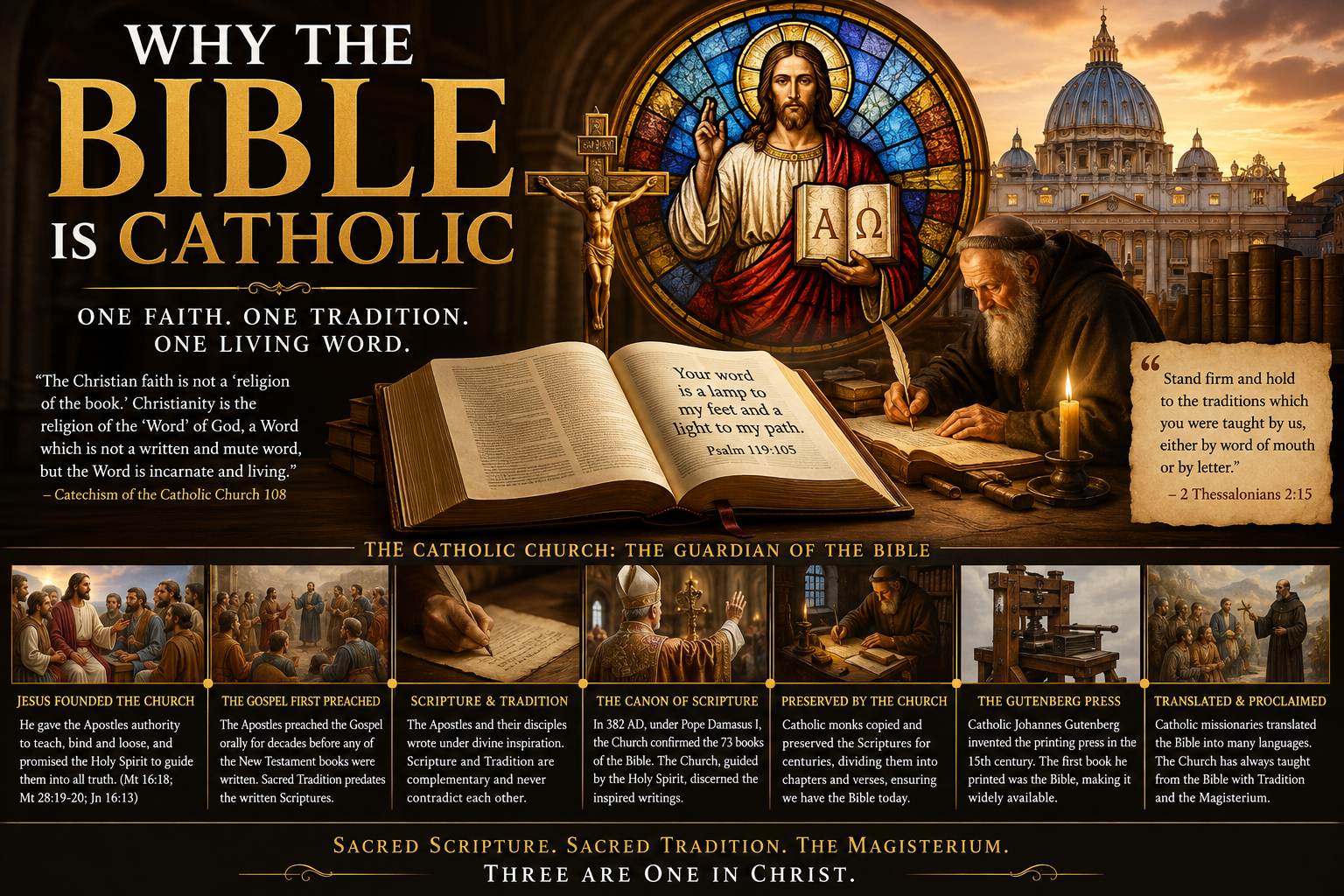
Jesus did not write a book. He founded a Church. He said to Simon, “You are Peter, and on this rock I will build my Church” Matthew 16:18. He entrusted His authority to the Apostles, commanding them to teach all nations and promising to remain with them until the end of the age Matthew 28:19 and 20. He also promised that the Holy Spirit would guide them into all truth John 16:13. This teaching authority is what the Church calls the Magisterium.
Before a single book of the New Testament existed, the Gospel was preached by word of mouth. The Apostles travelled from city to city proclaiming the death and resurrection of Christ. Thousands became Christians by listening to their preaching, not by reading the New Testament, because it had not yet been completed. This Sacred Tradition is as ancient as the Church itself.
Later, under the inspiration of the Holy Spirit, some Apostles and their companions wrote the books that now form the New Testament. Yet the written word never replaced the living Tradition of the Church. Both were handed on together. Saint Paul instructed believers, “Stand firm and hold to the traditions which you were taught by us, either by word of mouth or by letter” 2 Thessalonians 2:15. Scripture and Tradition are therefore two ways by which the one Gospel has been faithfully transmitted.
The Catholic Church has always taught that Sacred Scripture, Sacred Tradition, and the Magisterium cannot be separated. The Catechism of the Catholic Church explains that all three work together under the guidance of the Holy Spirit to preserve the fullness of divine revelation. Remove one, and the others are weakened.
Another important question is this. Who decided which books belong in the Bible? During the first centuries many writings claimed to be inspired. Some contained serious errors while others falsely claimed apostolic authorship. Guided by the Holy Spirit, the Church carefully examined these writings. Under Pope Damasus the Canon of Scripture was officially confirmed in the year 382, recognizing the forty six books of the Old Testament and the twenty seven books of the New Testament. Without the authority of the Catholic Church, there would be no universally recognized Bible.
The Church also preserved the Bible through centuries of hardship. Before the invention of the printing press every copy had to be written by hand. Catholic monks dedicated their lives to copying the Scriptures with extraordinary care. They preserved the sacred text, decorated manuscripts with beautiful artwork, and ensured that future generations would receive God’s word intact. Their quiet labor became one of the greatest services ever offered to Christianity.
The Church never opposed the Bible. Catholic missionaries translated the Scriptures into many languages to spread the Gospel. Saints Cyril and Methodius even created an alphabet to translate the Bible for the Slavic peoples. Medieval universities centered theological study on the Sacred Scriptures, and great saints such as Saint Thomas Aquinas devoted their lives to explaining the word of God faithfully.
During the Protestant Reformation, the doctrine of Scripture alone became popular. Yet the Bible itself never teaches Scripture alone. Instead it points believers to both the written word and the living Tradition of the Apostles. Saint Peter also warns that no prophecy of Scripture is a matter of private interpretation 2 Peter 1:20 and 21. Christ established a teaching Church so that His truth would remain united and protected from error.
For Catholics, the Bible is not separated from the Church that preserved it. The same Holy Spirit who inspired the sacred authors continues to guide the Church in faithfully interpreting God’s word. This is why Catholics read Scripture within the communion of the Church, nourished by the wisdom of the Fathers, the teachings of the Councils, the witness of the Saints, and the living Magisterium.
The Bible is therefore truly Catholic because it was written within the Church, preserved by the Church, recognized by the Church, and faithfully proclaimed by the Church throughout every generation. As the Catechism beautifully teaches, Christianity is not simply a religion of a book. It is the religion of the living Word of God, Jesus Christ, who continues to speak through Sacred Scripture, Sacred Tradition, and His Holy Church.
About the Author