
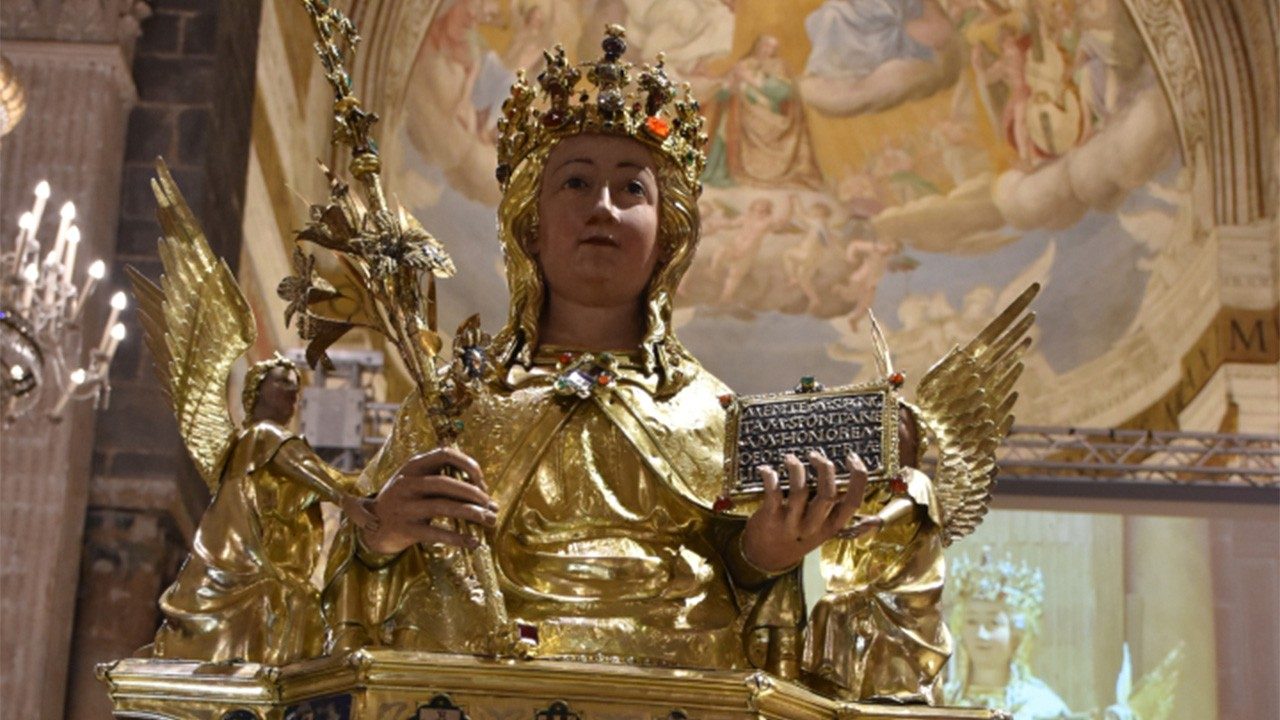
There has been a video circulating widely in recent days. Understandably, it has unsettled many people, including some of us practising Catholics. It is a video of the Archbishop of Catania, Luigi Renna, presiding over an elaborate veneration of the relics of St Agatha of Catania, which includes the ceremonial crowning of the reliquary containing her bodily remains by the Papal Legate Cardinal Pietro Parolin.
That occasion was the 900th anniversary of the return of St Agatha’s bodily remains to Catania, Sicily, her home town. Recall that St Agatha’s relics had previously been stolen by the Byzantine general George Maniaces (Giorgio Maniace) in 1040 and taken to Constantinople. According to the tradition surrounding their return, two soldiers, Gisliberto and Goselmo, recovered the relics, and they were returned to Catania on August 17, 1126, after about 86 years away from the city.
So, one can understand the joy the people of Catania felt when the relics of one they considered their own were brought back after such a long absence. It’s the same joy that is seen in the viral video of the crowning of the reliquary bust, where Cardinal Parolin, acts under the official mandate of Pope Leo XIV, who appointed him as his pontifical legate for the celebrations of 16 – 18 August 2026 (Vatican News, 2026). The significance of the presence of the Papal Legate is that it is Pope Leo XIV himself who is extending recognition to Catania’s devotion of St. Agatha, thereby elevating a local anniversary into an event of universal Church significance.
Is this devotion taken too far?
The Directory on Popular Piety and the Liturgy (2001) recognises practices such as kissing relics, decorating them with flowers and lights, and carrying them in procession. These practices, it says, can be legitimate when carried out with dignity and motivated by faith (DPPL, no. 237). What about crowning the skull of a saint?
Strictly speaking, one cannot argue that the act is contrary to Catholic doctrine. The crown does not necessarily mean that Catholics believe the skull or the reliquary bust is a deity. The ceremonial language surrounding St Agatha is intended to honour the saint whose martyrdom is understood as a participation in Christ’s victory.
Nonetheless, the ceremony raises some legitimate concerns, especially in our age of social media. A medieval Sicilian Catholic participating in a local devotional tradition may have understood perfectly what the crown symbolised. But someone watching a fifteen-second video on TikTok, Facebook, Instagram or X may see something entirely different.
The image of a Catholic Archbishop showing a human skull to the people for veneration, before placing it inside a reliquary for crowning by a Cardinal is nerve wracking. The immediate visual impression is rattling. The optics are unsettling for many.
It can look like the sacralisation of human remains. It can look like ancestor veneration. It can even look, to someone without adequate catechesis, like the worship of a human skull.
The Church does not worship bones
As some of my brothers and sisters have already noted, the Catholic Church makes a fundamental distinction between worship and veneration. This is the foundation on which the whole argument rests. Worship, or latria, belongs to God alone. The saints are honoured, not worshipped.
Hence, although some Catholics and non-Catholics may erroneously hold the opinion that we adore the physical remains of saints, the reality is that we do not. The body parts, clothing, or any such material closely related to, or used by saints do not possess any divinity. It would not make sense to adore them.
The DPPL (2001) describes relics principally as the bodies or notable parts of the bodies of saints who lived on earth, belonged to Christ and are now understood to dwell with God. It also recognises objects belonging to saints, or things that have touched their bodies or tombs, as relics (no. 236).
Catholics do not regard the human body as an insignificant shell that is simply discarded after death. This is why we believe in the resurrection of the body and life everlasting. In St. Agatha’s case, as in related cases, her body belonged to someone who lived a life of faith, participated in the life of Christ and, according to Christian hope, now ultimately shares in the resurrection.
The relic therefore points beyond itself. Put differently, a Catholic does not venerate St Agatha’s remains because they are divine. The Catholic venerates them because they belonged to St. Agatha, a person believed to have been sanctified by God’s grace and who now shares in heavenly glory.
This is why the Vatican’s explanation of the current celebrations describes St Agatha as a continuing sign of the communion between the Church on earth and those who have entered heavenly glory. Pope Leo’s message presents her martyrdom as a testimony to the victory of grace over violence, faith over fear and charity over death (Vatican News, 2026).
How is this different from ancestor worship in Africa?
There are indeed similarities between ancestor veneration and our understanding of the veneration of saints. For instance, just as ancestors are not simply regarded as people who ceased to exist at death, so also is the Catholic understanding that physical death does not stop the bond between the saints and us who are still alive.
However, the Catholic understanding of the saint may not be identical to traditional ancestor worship or veneration in some ways. The Catholic saint is not simply a deceased member of one’s biological lineage whose spiritual influence is invoked through his or her remains.
The saint’s significance derives from Jesus Christ. In Catholic theology, the saint is honoured because of God’s action in his or her life and because he or she participates in the glory of God. The saint’s holiness is understood not as an independent spiritual power, but as the fruit of God’s grace and the person’s response to that grace. The saint’s intercession is therefore sought from God. He or she is not treated as an independent source of power, as may often be the case in ancestor veneration.
This is where Catholic catechesis becomes indispensable. The Church does not teach that the physical remains of a saint constitute some kind of supernatural battery. A relic must not be understood to function like an occult object. The Catholic is not supposed to think, “Oh, if I touch this bone, supernatural energy will enter me,” or, “This piece of the saint will protect me from evil.”
It is precisely for this reason that the Church warns against the superstitious use of relics (DPPL, no. 237). If devotion to relics becomes an attempt to obtain supernatural power from a physical object, something has gone seriously wrong. The Directory itself calls for the prevention of “fraud, trafficking, or superstition” in relation to relics. (DPPL, no 237).
And in the case of the viral video, if people become more fascinated by the skull than by St Agatha’s fidelity to Christ, the devotion has lost its centre. This means the relic is successful only insofar as it directs attention beyond itself.
Did it achieve this in this case? To the immediate audience, absolutely. To the rest of us on social media, who are not Catholics, or who do not understand the story behind the devotion to St. Agatha, maybe not. And perhaps this gives us a useful test for all Catholic popular devotion:
Does this devotion ultimately make Christ more visible, or does the devotional object itself become the centre of attention? There is a great sense in which the problem in this case has been heightened by social media, and inadequate pastoral communication. A short reel, without proper description, showing a Bishop with a skull has nearly turned an entire solemn rite into mere spectacle.
In conclusion, I would reject two extremes. The first extreme is that Catholics worship relics. We do not. The second is to presume that since we do not worship relics, there is absolutely nothing to discuss. There is.
One can accept relics without being comfortable with every manner in which they are displayed. Similarly, one can honour the saints without wanting devotional practices to become so elaborate that they risk obscuring the very Christ to whom the saints bore witness.
Indeed, perhaps the better Catholic response is not simply to dismiss the discomfort of those who watched the video, but to use the moment as an opportunity for deeper catechesis about relics, the saints, the human body, the resurrection and, above all, the fact that the saints point beyond themselves to Christ.
© Oselumhense Anetor, 2026
References
- Aurite, C. (2026). https://en.lasicilia.it/video/home/3066538/in-catania-the-peak-of-the-agatino-year-saint-agatha-crowned-900-years-after-the-translation.html
- Vatican News. (2026) Pope: Saint Agatha demonstrates the victory of love over death. https://www.vaticannews.va/en/pope/news/2026-08/pope-saint-agatha-demonstrates-the-victory-of-love-over-death.html
- Congregation for Divine Worship and the Discipline of the Sacraments. (2001). Directory on popular piety and the liturgy: Principles and guidelines. https://www.vatican.va/roman_curia/congregations/ccdds/documents/rc_con_ccdds_doc_20020513_vers-direttorio_en.html
About the Author

Cathecesis is urgently needed in the Catholic Church. Priests with knowledge such as yours should devote few minutes at homilies for such. One question per Mass on Sunday could be magical. Some of us born Catholics will just similate this theory but frankly, we need education
Very well said.