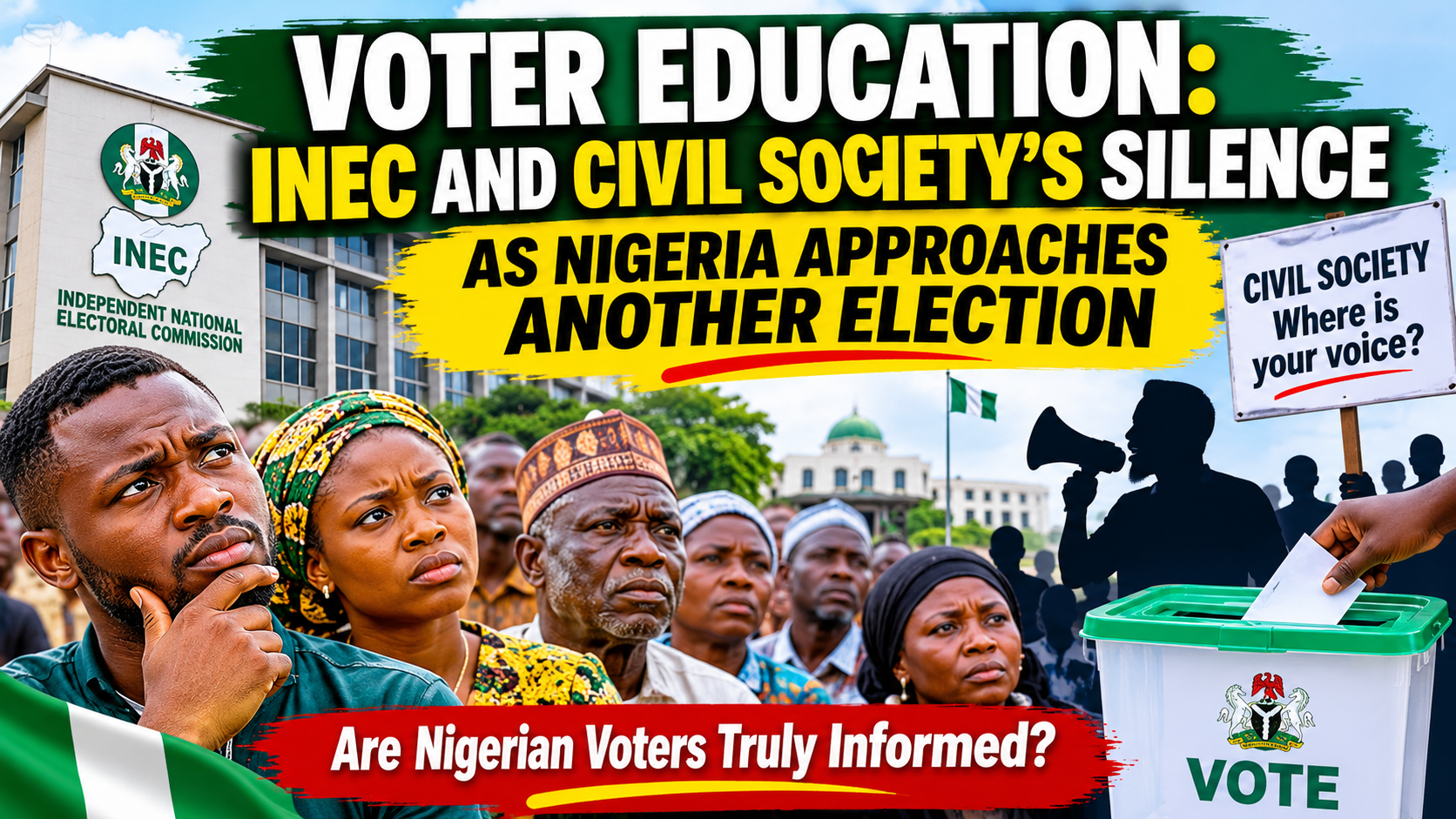
An uninformed electorate is vulnerable to manipulation. Who is preparing Nigerian voters for 2027?
Nigeria is approaching another defining moment in its democratic journey. With the presidential and National Assembly elections scheduled for January 16, 2027, and the governorship and State Houses of Assembly elections fixed for February 6, the countdown has entered a critical stage.
Yet, beyond political rallies, defections, campaign promises, party supremacy battles and the endless calculations of political interests, one important question deserves national attention: How prepared are Nigerian voters to make informed electoral decisions?
Democracy is not sustained by elections alone. It thrives when citizens understand the power of their votes, appreciate their constitutional rights and recognise their responsibilities in choosing those who govern them.
Unfortunately, voter education remains one of the areas where Nigeria’s electoral preparation deserves greater attention.
The problem is not necessarily that Nigerians lack political opinions. On the contrary, political discussions are everywhere. From motor parks to markets, religious gatherings, social media platforms and community meetings, Nigerians have something to say about politics.
But having an opinion is not the same as being politically informed.
Many voters still struggle to distinguish between campaign propaganda and verifiable policy commitments. Some do not fully understand the voting process, the responsibilities of different political offices, the importance of ballot secrecy or the procedures for reporting electoral violations.
Others approach elections with little knowledge of how to assess candidates beyond party affiliation, ethnicity, religion, financial inducements and political popularity.
This raises serious questions about the effectiveness of the institutions and organisations entrusted with promoting electoral awareness.
INEC: MORE THAN ORGANISING ELECTIONS
The Independent National Electoral Commission (INEC) has a constitutional and statutory responsibility that extends beyond printing ballot papers, deploying electoral materials and announcing election results.
Section 2 of the Electoral Act 2022 expressly recognised voter and civic education as one of the Commission’s functions. The new electoral framework must also be communicated clearly to the electorate.
However, voter education should not be treated as an occasional publicity exercise that becomes visible only when elections approach.
INEC must move beyond press statements, official social media announcements and occasional sensitisation programmes.
The Commission needs a sustained, nationwide public education campaign that reaches ordinary Nigerians in languages and formats they understand.
How many voters know what to do when their names are missing from the register? How many understand the accreditation process? How many know that their votes are secret and that nobody has the right to demand proof of whom they voted for?
How many understand the role of the Bimodal Voter Accreditation System (BVAS), the importance of polling unit results and the appropriate channels for reporting electoral misconduct?
These are not complicated questions, but they have significant implications for electoral participation and credibility.
INEC should organise practical demonstrations of the voting process, produce simplified guides in local languages, engage traditional rulers, religious institutions, market associations, youth groups and community organisations.
It must also explain the new electoral laws and regulations in accessible language rather than assume that publishing legal documents on its website is sufficient.
An election manual that citizens cannot understand is not effective voter education.
WHERE ARE THE CIVIL SOCIETY ORGANISATIONS?
Civil society organisations (CSOs) occupy an important position in Nigeria’s democratic development.
They are expected to serve as watchdogs, promote accountability, defend citizens’ rights, monitor electoral processes and encourage informed public participation.
Yet, there is a legitimate question about the visibility, reach and effectiveness of their voter education activities.
Some organisations are active during election observation, press conferences, stakeholder meetings and the publication of election reports. These activities are important, but they represent only part of their responsibilities.
Voter education should not begin and end with election observation.
Where are the sustained grassroots campaigns explaining how citizens can independently evaluate candidates? Where are the community engagements teaching voters how to recognise vote buying, reject electoral intimidation and report violations?
Where are the simplified educational materials explaining the difference between the responsibilities of a councillor, local government chairman, state legislator, governor, member of the National Assembly and the President?
Nigerians must understand that different public offices have different constitutional responsibilities.
A presidential candidate should not be judged solely by promises concerning matters outside the direct control of the presidency. Similarly, a legislator should be assessed by more than the number of empowerment programmes or personal gifts distributed to constituents.
Civil society organisations must help citizens understand these distinctions.
They should also be transparent about their funding, partnerships and activities to strengthen public confidence in their independence.
WHAT SHOULD CHANGE BEFORE JANUARY 2027?
With barely more than two months before the first major round of the general elections, there is little justification for treating voter education as a secondary concern.
INEC and civil society organisations need to intensify their efforts in several critical areas.
1. Take voter education to the grassroots.
Sensitisation must reach rural communities, markets, schools, motor parks, religious centres and areas with limited access to digital information.
Television and social media alone cannot educate an entire electorate.
2. Educate voters on the power of their ballot.
Citizens must understand that voting is a constitutional right and a democratic responsibility. They should know that their choices are personal and that nobody should intimidate or coerce them into supporting a candidate.
3. Explain the electoral process in simple language.
INEC should demonstrate accreditation, voting, ballot counting, result recording and the procedures for reporting irregularities. Citizens should understand what happens at polling units before, during and after voting.
4. Fight misinformation and electoral propaganda.
False information spreads rapidly, particularly during election periods. INEC and independent civic organisations should establish visible channels for verifying electoral information and correcting misleading claims.
5. Educate voters on evaluating candidates.
Voters should be encouraged to examine candidates’ records, qualifications, public conduct, policy proposals and understanding of the responsibilities of the offices they seek.
This education must remain non-partisan. Its purpose is not to tell Nigerians whom to vote for but to help them understand how to make independent decisions.
6. Prioritise vulnerable and marginalised voters.
Persons with disabilities, internally displaced persons, elderly citizens, women and voters in remote communities require deliberate attention.
An electoral process cannot claim to be inclusive if significant sections of the population are left without the information or practical assistance required to participate.
DEMOCRACY NEEDS INFORMED CITIZENS, NOT JUST EXCITED VOTERS
One of the dangers facing Nigerian democracy is the tendency to confuse political enthusiasm with democratic awareness.
A citizen who can passionately defend a political party but cannot explain what the party’s candidate intends to do differently may be politically active without being sufficiently informed.
Similarly, a voter who collects money in exchange for a ballot may not fully appreciate the long-term consequences of that transaction.
This is why voter education must address not only the mechanics of voting but also the values that sustain democracy: accountability, tolerance, independent judgment, peaceful participation and respect for the rule of law.
Political parties also have a responsibility. They must educate their supporters on peaceful conduct, respect for electoral rules and the importance of accepting lawful electoral procedures.
The media, religious institutions, traditional rulers, educational institutions and community leaders must equally recognise that democracy is a shared responsibility.
THE REAL QUESTION
INEC cannot single-handedly educate an electorate as large and diverse as Nigeria’s. Civil society organisations cannot do it alone either.
But their inability to work independently should not become an excuse for inadequate public engagement.
The 2027 general elections should not be reduced to a contest of political machinery, financial influence, propaganda and party loyalty.
They should also be an opportunity to strengthen citizens’ understanding of their democratic power.
Ultimately, the credibility of an election is not determined only by the efficiency of electoral technology or the professionalism of election officials. It is also influenced by how well citizens understand the process, exercise their rights and hold public institutions accountable.
INEC must do more. Civil society organisations must do more. The media must do more.
And Nigerians must demand more.
Because a democracy in which citizens are mobilised to vote but inadequately educated about what their votes mean risks producing participation without meaningful understanding.
The question is no longer whether Nigerians are ready to vote. The more important question is whether the institutions responsible for educating them are doing enough to prepare them for the responsibility.
About The Author