First Sunday of Advent, Year B
Is. 63:16-17; 64:1, 3-8; Ps. 80:2-3, 15-16, 18-19; 1 Cor. 1:3-9; Mark 13:33-37.
It’s Advent Season again, and I know that you can feel the change in the Liturgical Year. The green vestments are gone, violet is out, and we can see the Advent wreath in the sanctuary in many of our Churches.
So, Happy New Liturgical Year B to you, my dear brothers and sisters. Over the last few days, I have witnessed the installation of Christmas lights, the setting up of Christmas trees, choristers rehearsing Christmas carols, and so on.
“But it’s not yet Christmas,” you might say. To this, I respond, “Christmas is coming,” and “we must prepare”. It is for this reason that the Church gives us ADVENT – four weeks of preparation for the Holy Season of Christmas.
Advent starts today, the fourth Sunday before Christmas, and will last until the evening of Christmas Eve, which is December 24th.
To properly understand Advent, let us look at two Latin words:
The first is ADVENIRE, which is a combination of ad, meaning “to or towards”, and venire, meaning “to come”. It is a verb meaning “to arrive” or “to come to”.
The second word is ADVENTUS, which is a noun meaning “arrival” or “coming” (and is the source of the English word “Advent”).
Advent, therefore, means, in our Christian context, the arrival or coming of Jesus Christ.
But Christ has already come. Is he coming again? Bishop Robert Barron talks about three comings of Jesus Christ. He says Jesus comes in history, Jesus comes now in our hearts, and Jesus will come at the end of time.
So there is past, present and future, and Advent prepares us to appreciate all three comings of Jesus Christ.
Jesus did step into our human history. He became man, dwelt among us, and completely transformed our salvation trajectory. So, as we come to Advent, we must look back to this coming as a turning point in our Christian history. He is the focal point of time, and even our conventional calendar takes his coming as its reference point. For instance, we are now in the year 2026 AD – Anno Domini, meaning “in the year of our Lord”.
In the first reading of today, the prophet Isaiah expresses humanity’s longing for divine intervention: “O that you would tear the heavens open and come down!” The people had wandered away from God. They had become conscious of their sins and the consequences of their unfaithfulness. Yet, in the midst of their misery, they recognised that God was still their Father. They were the clay, and God was the potter.
This cry of Isaiah finds its ultimate fulfilment in the mystery of the Incarnation. God did come down. He took on our human nature and dwelt among us. What we celebrate at Christmas is God’s response to humanity’s longing for salvation.
Second, Christ comes into our hearts now. The same Jesus who came into history, lived and died, rose, and is now with the Father, knocks at the door of my heart now. He knocks at the door of your heart now.
There is a story of a famous painting titled The Light of the World, painted by the artist William Holman Hunt (1827–1910).
The painting is of the figure of Jesus preparing to knock on an overgrown and long-unopened door with no handle on the outside.
It illustrates Revelation 3:20: “Behold, I stand at the door and knock; if any man hear My voice, and open the door, I will come in to him, and will sup with him, and he with Me.”
One striking feature of this painting is the missing door handle. But the omission was deliberate. According to Hunt, the painter, the door represents the obstinately shut mind. The door has no handle on the outside and can, therefore, be opened only from the inside.
Dear friends, is my heart obstinate? Am I so stubborn that I’ve left Jesus Christ standing outside the door of my heart, refusing to let him in? Advent reminds me to OPEN the door. Advent reminds me to come back to God, to come back to the Church, to come back to the Sacraments.
This is precisely why we pray in the Responsorial Psalm of today: “God of hosts, bring us back; let your face shine on us and we shall be saved.”
Like the people of Israel, we sometimes wander so far away from God that we begin to lose consciousness of how far we have wandered. Advent gives us an opportunity to retrace our steps. When last did I go to confession? When last did I receive Holy Communion in a state of grace? When last did I forgive someone who offended me? Of what use is it to prepare my house for Christmas when the door of my heart remains firmly shut against Christ?
Third, Jesus is coming again at the end of time to bring all things to fulfilment. We call this the Parousia (the Second Coming). It is in the light of this Second Coming that we say “Marana Tha”, an Aramaic phrase meaning “Come, O Lord!”
In the second reading, St Paul thanks God for the graces bestowed on the Corinthians through Jesus Christ. They have been enriched in speech and knowledge and are not lacking in any spiritual gift as they wait for the revelation of our Lord Jesus Christ. Paul assures them that God is faithful and will sustain them to the end.
In other words, God has not left us without the resources with which to prepare for his coming. He has given us his Word, the Sacraments, the gift of the Holy Spirit and the fellowship of the Christian community. But what are we doing with these gifts?
It is in this light that we must understand the words of Jesus in today’s Gospel: “Be on your guard, stay awake, because you never know when the time will come.”
Jesus compares his coming to that of a man who travels abroad, leaving his servants in charge of his household, each with his own task, and instructing the doorkeeper to stay awake.
Notice that Jesus does not simply ask the servants to wait. He gives each of them a task. Christian vigilance, therefore, is not about sitting idly and looking towards the heavens in expectation of Christ’s return. It is about faithfully carrying out the responsibilities that God has entrusted to us, so that whenever he comes, he will find us doing what we ought to be doing.
Advent calls us to prepare for all three comings of Jesus.
But what does all this mean for us in Nigeria today?
When we consider the insecurity in our country, the kidnappings, the killings, the hunger, the poverty, the corruption and the difficulties many Nigerian families face in putting food on their tables, can we not identify with the cry of Isaiah in the first reading? Do we not sometimes find ourselves asking God to tear the heavens open and come down?
But what if the God we are asking to come down is already knocking at the doors of our hearts? What if the problem is that we have refused to let him in?
We cannot continue to pray for a better Nigeria while refusing to become better Nigerians. We cannot ask God to deliver us from corruption while perpetuating corruption in our little corners. We cannot pray for justice while denying others their rights. We cannot sing Christmas carols about peace on earth while promoting hatred, ethnic and religious intolerance, and violence against one another.
For those in positions of authority, staying awake means being alive to the responsibilities of leadership. For the security personnel, it means being committed to the protection of lives and property. For the trader, it means not taking undue advantage of the desperation of customers during the festive season. For the Christian, it means recognising Jesus in the hungry, the displaced, the grieving and the forgotten.
Perhaps the reason Christ has been knocking for so long is that many of us want him to change our circumstances without allowing him to change us.
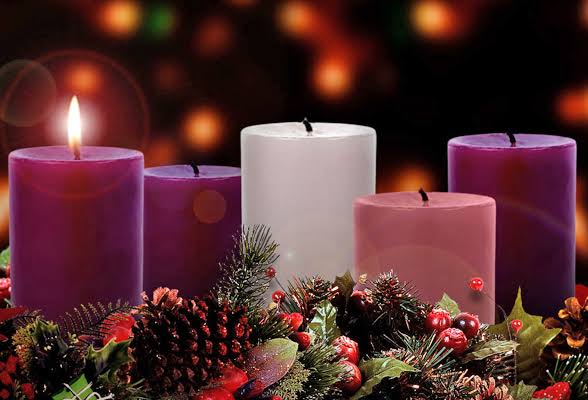
And this brings me to the significance of the Advent wreath in our Christian tradition.
The Advent wreath is not just another Christmas decoration. Its circular shape, having neither beginning nor end, reminds us of the eternity of God and his everlasting love for us. The evergreen branches symbolise the hope of eternal life in Christ, even in the midst of the uncertainties of our earthly existence.
The four candles represent the four weeks of Advent. Traditionally, three are violet and one is rose-coloured. The violet candles remind us of the need for prayer, repentance and spiritual preparation, while the rose-coloured candle, lit on the third Sunday of Advent, which we call Gaudete Sunday, reminds us to rejoice because the Lord is near.
The candles are also commonly associated with hope (the Prophet’s Candle), peace (Bethlehem Candle), joy (Shepherd’s Candle) and love (Angel’s Candle). With each passing Sunday, another candle is lit, and the light becomes brighter as we draw closer to Christmas. This reminds us that Jesus Christ, the Light of the World, comes to dispel the darkness of sin and death.
For us in Nigeria today, this symbolism is particularly meaningful. In a country where so many people seem to be losing hope, where peace is threatened, where the circumstances of life rob many of their joy, and where selfishness increasingly takes the place of love, the Advent wreath reminds us that darkness does not have the final word.
But as we light these candles in our Churches, can we also light the candles of hope in the lives of those who have become hopeless? Can we bring peace to our troubled communities, joy to those who mourn, and love to those who have been abandoned?
Dear friends, by Christmas Eve, we may have put up our Christmas trees, installed beautiful Christmas lights, bought new clothes, rehearsed our carols and made elaborate preparations for Christmas celebrations. But would we have opened the doors of our hearts to Christ?
The question is not whether Christ is coming. The question is whether we are READY to receive HIM.
May the Lord find us awake when he comes. May he mould us once again in accordance with his divine will, for we are the clay and he is the potter. May his face shine upon us, upon our families and upon our dear country Nigeria, that we may be saved. Amen.
Marana Tha! Come, O Lord Jesus!
Happy Sunday, Happy Advent, and Happy New Liturgical Year!
About The Author