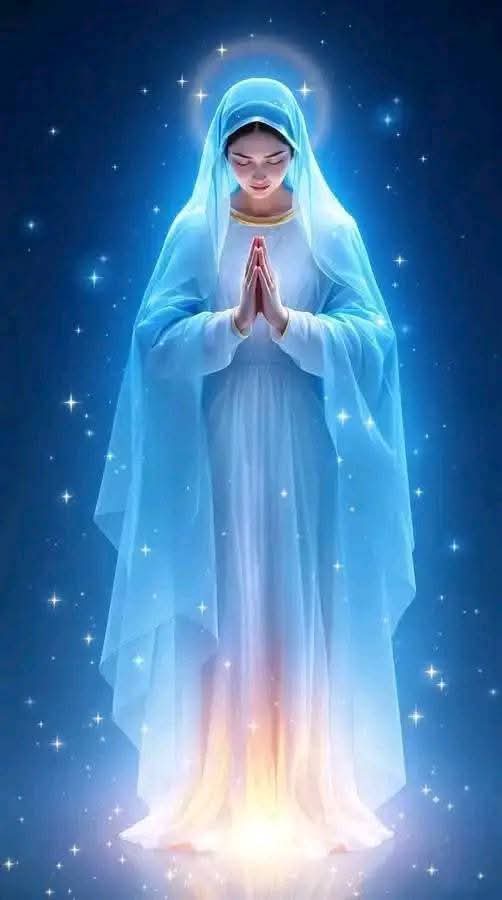
One of the most misunderstood teachings of the Catholic Church is its devotion to the Blessed Virgin Mary. Because Catholics pray the Rosary, celebrate Marian feast days, visit Marian shrines, and use titles such as Mother of God, Queen of Heaven, and Mother of the Church, many people conclude that Catholics worship Mary. The Church, however, firmly rejects this claim.
The Catholic Church teaches that God alone is worshipped. Worship, known in theology as latria, belongs only to the Holy Trinity—Father, Son, and Holy Spirit. Mary, despite her unique role in salvation history, is a creature redeemed by Christ. She is never considered divine.
Instead, Catholics give Mary veneration, a profound form of honor that recognizes her unique place in God’s plan. The Church uses the term hyperdulia to describe this special honor. It is greater than the dulia (honor) given to other saints, yet infinitely different from the latria reserved for God alone. This distinction has been part of Catholic theology for centuries.
Why is Mary given such extraordinary honor? The answer lies in Jesus Christ. At the Council of Ephesus (431 AD), the Church declared Mary Theotokos (“Mother of God”). This title does not mean Mary existed before God or created God. Rather, it safeguards the truth that Jesus Christ is fully God and fully man. Since the child she bore is God incarnate, she is rightly called the Mother of God.
Catholic devotion to Mary is therefore Christ-centered. Every authentic Marian devotion is intended to lead believers closer to Jesus, not away from Him. As Mary herself says in Scripture, “Do whatever He tells you” (John 2:5). Her role is always to point people to Christ.
The Second Vatican Council reaffirmed this teaching by describing Mary as the Mother of the Church, emphasizing her maternal role in caring for believers while making clear that Christ remains the sole Redeemer and Mediator.
Over the centuries, saints such as Irenaeus of Lyons, Ambrose of Milan, Bernard of Clairvaux, John Duns Scotus, Ignatius of Loyola, Alphonsus Liguori, and Louis de Montfort deepened Marian devotion through their writings. These saints consistently taught that love for Mary should always strengthen faith in Jesus Christ. While some devotional expressions use poetic language that can sound exaggerated, the Holy See has repeatedly insisted on distinguishing true devotion from false devotion and authentic doctrine from excess.
Catholics also believe that the saints in heaven pray for the Church on earth. Therefore, asking Mary to pray for them is understood in the same way as asking a fellow Christian to pray for them—except that Mary, as the mother of Jesus and the foremost among the saints, holds a unique place in the communion of saints. Catholics do not believe she replaces Christ or acts independently of Him.
The Catechism of the Catholic Church summarizes this teaching clearly:
“The Church’s devotion to the Blessed Virgin is intrinsic to Christian worship… This very special devotion differs essentially from the adoration which is given to the incarnate Word and equally to the Father and the Holy Spirit.”
In short, Roman Catholics do not worship Mary. They worship God alone. Mary is honored because of her unique cooperation with God’s plan of salvation and because her life perfectly points believers to Jesus Christ. Authentic Catholic teaching insists that every Marian devotion should ultimately lead to deeper love, trust, and worship of Christ, who alone is Lord and Savior.
About the Author