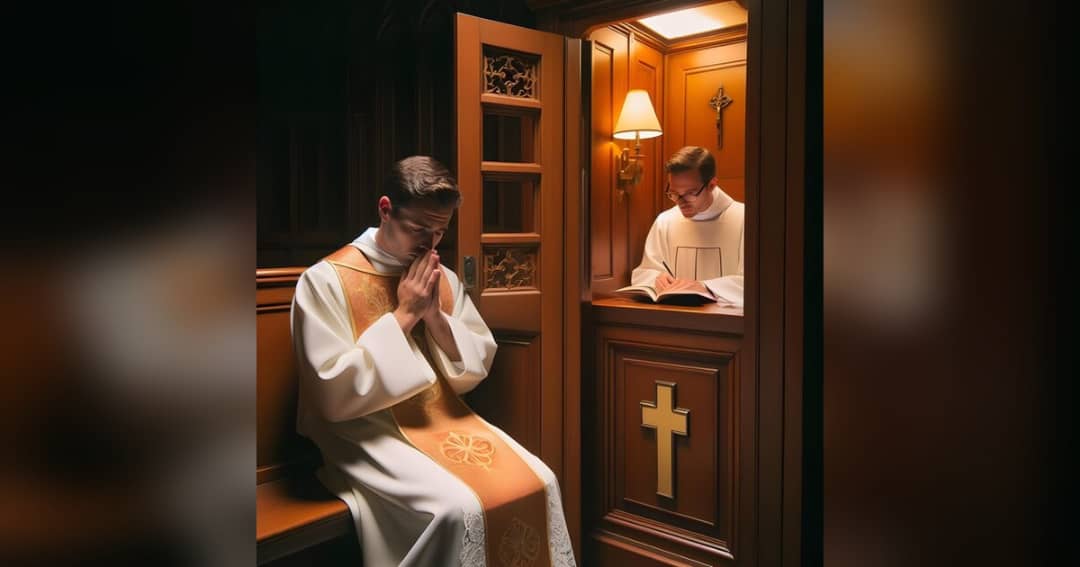
Among the most misunderstood teachings of the Catholic Church is the practice of confessing sins to a priest. Many ask, “Why should I confess my sins to a man when I can go directly to God?” The Catholic Church teaches that every sin is ultimately forgiven by God alone. However, Christ Himself established a visible means by which His forgiveness would be communicated to His people through the ministry of His Church.
The foundation of this teaching is found in the words of the risen Christ:
“Peace be with you. As the Father has sent me, even so I send you… Receive the Holy Spirit. If you forgive the sins of any, they are forgiven; if you retain the sins of any, they are retained” (John 20:21–23).
These are not merely words about forgiving personal offenses. Jesus had already commanded all Christians to forgive those who wrong them (Matthew 6:14–15), and He never gave believers the authority to retain another person’s sins. Here, however, He breathes the Holy Spirit upon the Apostles and entrusts them with His own divine mission. Just as the Father sent Christ to reconcile humanity to Himself, Christ now sends His Apostles to continue that ministry.
This authority reflects what Jesus demonstrated during His earthly ministry. When He forgave the paralytic’s sins (Mark 2:5–12), the scribes protested, “Who can forgive sins but God alone?” They were correct that only God can forgive sins. Yet Jesus proved He possessed that divine authority and later entrusted its sacramental exercise to His Apostles. In confession, therefore, the priest does not forgive by his own power; he acts in persona Christi—in the person of Christ—through the grace of Holy Orders.
The traditional Catholic rite beautifully expresses this reality. The penitent begins with the Sign of the Cross and the words, “Bless me, Father, for I have sinned,” acknowledging both personal sinfulness and trust in God’s mercy. After confessing sins sincerely and completely, the priest may offer spiritual counsel and assign a penance—not as a payment for forgiveness, but as an act of repentance and spiritual healing. The penitent then prays an Act of Contrition, expressing sorrow and the firm resolve to avoid sin. Finally comes the most sacred moment: the prayer of absolution. Stretching out his hand, the priest declares:
“God, the Father of mercies, through the death and resurrection of His Son has reconciled the world to Himself and sent the Holy Spirit among us for the forgiveness of sins; through the ministry of the Church may God grant you pardon and peace, and I absolve you from your sins in the name of the Father, and of the Son, and of the Holy Spirit.”
These are not merely comforting words but the sacramental proclamation of Christ’s mercy.
The ministry of confession is also supported elsewhere in Scripture. James instructs the faithful to call for the elders of the Church, whose prayers bring healing and forgiveness (James 5:14–15). Repentance remains essential, as Peter proclaimed: “Repent therefore, and turn again, that your sins may be blotted out” (Acts 3:19). The authority to forgive or retain sins necessarily implies that the minister must know the sins being judged, which explains the practice of confessing them.
The earliest Christians understood this. The Didache urged believers to confess their sins in the Church. Church Fathers such as Hippolytus, Origen, and St. Cyprian all testify that bishops and priests exercised Christ’s authority to forgive sins through sacramental confession. This continuous witness demonstrates that confession is not a medieval invention but an apostolic practice.
The roots of confession stretch even into the Old Testament, where God commanded His people to confess their sins before presenting their guilt offerings (Numbers 5:5–7; Leviticus 5:5). The New Covenant fulfills and perfects what the Old Covenant foreshadowed.
The Sacrament of Reconciliation is the ordinary means by which Catholics receive forgiveness after Baptism. While God is not limited by the sacraments and can forgive those who make a perfect act of contrition when confession is impossible, Catholics seek confession because Christ instituted it as a privileged channel of grace. Beyond forgiveness, it brings peace of conscience, spiritual direction, humility, and strength to resist future temptation.
Every confession is a personal encounter with the Good Shepherd who seeks the lost sheep. The priest is not merely a listener but an instrument of Christ’s mercy. In the confessional, heaven rejoices, the sinner is reconciled, and the words of Jesus are fulfilled: “Your sins are forgiven. Go in peace.”
As Catholics, have you ever experienced an inner peace that surpasses all understanding, as though a heavy burden has been lifted from your shoulders after going to confession? If you have been away from this sacrament, make out time to go for confession before tomorrow Sunday Mass, and allow Christ to restore your peace and joy.
About the Author