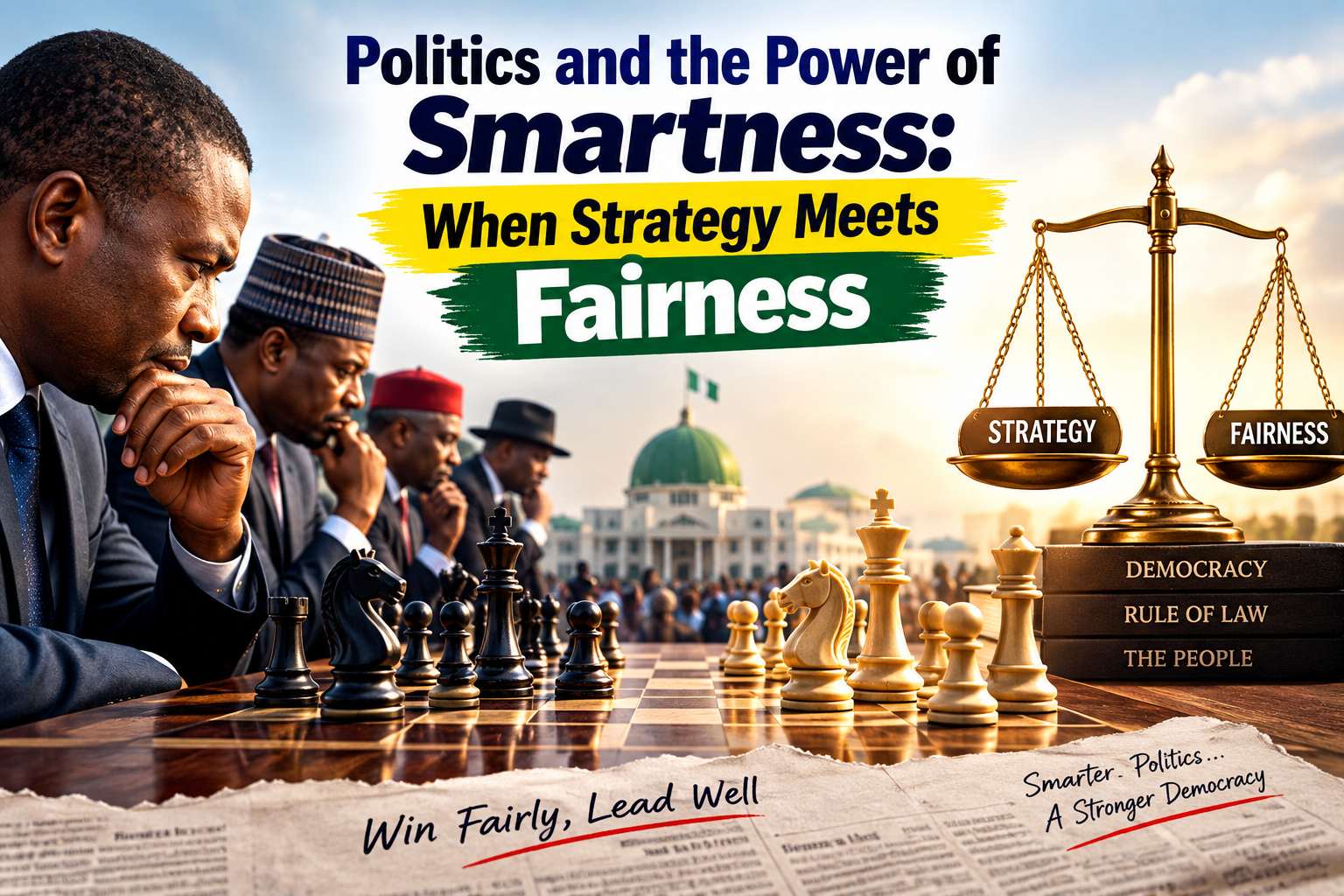
Politics is a game of numbers, alliances, timing, persuasion and, occasionally, extraordinary cleverness. But it is also supposed to be a game governed by rules.
That distinction matters.
Every politician, regardless of party, wants to outsmart the other. It is almost a job requirement. The politician who says he has no political strategy is probably the politician with the most secret strategy.
In politics, nobody wants to be the person who arrives at the negotiating table only to discover that everyone else has already negotiated.
So politicians scheme.
They build alliances. They count delegates. They study opponents. They anticipate moves. They make friends with people they privately dislike and sometimes embrace people they publicly condemned yesterday.
Then, when the strategy succeeds, everybody applauds.
“What a political masterstroke!”
But when the same politician is outmanoeuvred, the vocabulary changes dramatically.
Suddenly, it is:
“They manipulated the process!”
“This is political rascality!”
“Democracy is under threat!”
Of course, sometimes it really is.
And that is where we must be careful.
There is a difference between being outsmarted and being cheated.
If your opponent builds a stronger coalition, persuades more people, reads the political mood better and beats you within the rules, you cannot reasonably call that injustice simply because you lost.
But if your opponent buys votes, intimidates voters, falsifies results, weaponises state institutions or bends the rules specifically to eliminate you, that is not smartness.
That is cheating.
And cheating should not be romanticised as political genius.
The temptation in politics is to celebrate cleverness without asking whether the cleverness was fair.
A footballer who scores a brilliant goal after beating three defenders is skilful.
A footballer who quietly carries the ball across the touchline and tells the referee he didn’t see it is not a genius. He is a cheat who got away with it.
Politics should not be different.
The hypocrisy of political outrage
There is something amusing about political morality.
A politician can spend six months quietly building an elaborate coalition designed to defeat an opponent. He can persuade delegates, negotiate behind closed doors, recruit defectors and execute the plan with military precision.
When he wins, he calls it strategy.
When his opponent does precisely the same thing to him four years later, he calls it betrayal.
The same manoeuvre somehow changes its moral character depending on who is holding the steering wheel.
It reminds one of the old political joke: When I cross the floor, it is because I am following my conscience. When you cross the floor, you are a political prostitute.
That is the comedy of politics.
Everybody believes in principles—provided the principles do not stand between them and power.
But there is a serious issue underneath the humour.
Democracy cannot survive on smartness alone.
It requires fairness.
The smartest politician is not necessarily the best politician
We should also question our obsession with political cleverness.
A politician may be extraordinarily intelligent at winning elections and still be terrible at governing.
He may know how to manipulate delegates but not how to build institutions.
He may know how to defeat opponents but not how to unite citizens.
He may understand the mathematics of power while completely misunderstanding the economics of ordinary families.
Winning the political game is not the same as winning the confidence of the people.
Indeed, some of history’s most celebrated political tacticians were brilliant at acquiring power but less impressive in what they did with it.
The ultimate test of political intelligence should therefore not simply be:
“How cleverly did you defeat your opponent?”
It should also be:
“What did you do with the power you acquired?”
That is where smartness meets responsibility.
And fairness does not mean everybody must win
There is another misunderstanding worth correcting.
Fairness does not mean every politician must have the same outcome.
If two candidates enter a contest under the same rules, one will win and one will lose. That is democracy.
The loser may be disappointed. He may even be angry.
But disappointment is not evidence of injustice.
If your opponent mobilised better, communicated better, negotiated better and earned more support, congratulations to him.
You lost.
It happens.
The mature response is not necessarily to declare the entire process fraudulent because the result did not favour you.
But the reverse is equally true.
The winner should not assume that victory automatically proves that everything was fair.
Winning does not sanctify the method.
That is an important lesson for every political party.
The dangerous line
The real danger begins when politicians confuse political intelligence with the ability to manipulate the rules.
There is nothing inherently wrong with being politically clever.
In fact, democracy needs people who can negotiate, compromise, organise and build coalitions.
But when political cleverness becomes an excuse for intimidation, corruption, electoral manipulation or the capture of institutions, society pays the price.
A democracy in which everyone is trying to outsmart everyone else eventually becomes a democracy in which nobody trusts the rules.
And once citizens stop believing that the rules matter, politics becomes a contest not of ideas but of who has the deepest pocket, the strongest connections or the greatest capacity to bend the system.
That is not smart politics.
That is institutional decay.
The electorate must become smarter too
Perhaps the greatest irony is that politicians spend so much energy trying to outsmart one another while the electorate is often expected simply to clap.
We should do better.
When a politician loses, we should ask:
Was he cheated, or was he simply outplayed?
When a politician wins, we should ask:
Did he win fairly, or did he manipulate the game?
Those are two different questions.
We must resist the lazy habit of believing that our candidate is always the victim and the opponent is always the villain.
Sometimes our candidate was cheated.
Sometimes he was simply outsmarted.
Sometimes the opponent genuinely won.
And sometimes the opponent won by methods that should concern every citizen, regardless of party affiliation.
The ability to distinguish these things is part of political maturity.
In the end, fairness must trump smartness
Politics will always involve strategy.
Politicians will continue to calculate, scheme, negotiate, form alliances and try to anticipate one another’s moves. That is unlikely to disappear.
And perhaps it shouldn’t.
But there must be a boundary.
Be clever, but play by the rules.
Be strategic, but do not destroy the rules in order to win.
Outmanoeuvre your opponent, but do not disenfranchise him.
And when you lose, have the courage to ask whether you were actually cheated—or whether somebody simply played the game better.
That is the humility politics desperately needs.
Because there is nothing wrong with losing to a smarter opponent.
There is everything wrong with being cheated.
And there is something even worse:
cheating your way to victory and then having the audacity to call yourself a genius.
In the theatre of politics, everybody wants to be the smartest person in the room.
But democracy has a more important demand:
Let the smartest player win—provided everyone is playing by the same rules.
About the Author