Nigeria never runs out of surprises. Just when many thought the Presidential Foreign Investment Promotion Council was another obscure government agency quietly operating in Abuja, the entire institution turned out to be nothing more than a spectacular work of fiction.
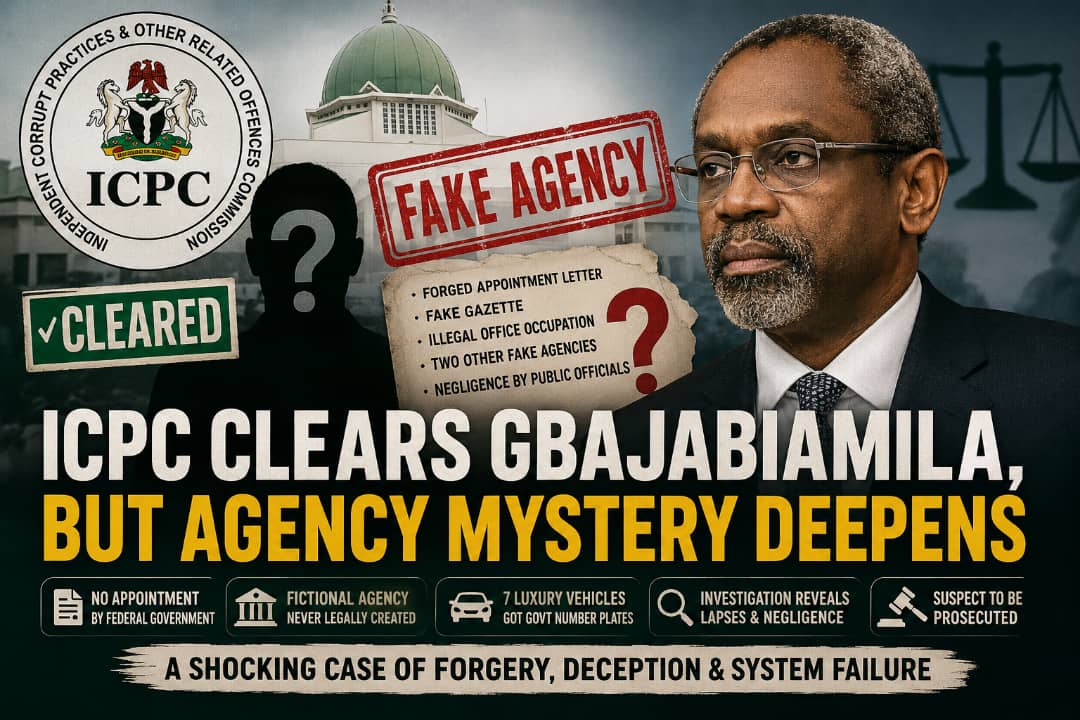
According to the Independent Corrupt Practices and Other Related Offences Commission, the agency never existed. It was not created by law. It was not established by executive order. It had no legal foundation. Yet it had an office, official looking documents, government style letterheads, a website, branded vehicles, and enough confidence to convince several public institutions that it was real. Yet questions remain about how such a structure passed through multiple layers of government scrutiny without being flagged earlier.
If confidence were a constitutional requirement for creating government agencies, this one would probably have qualified.
After a month long investigation ordered by President Bola Tinubu, the ICPC cleared the President’s Chief of Staff, Femi Gbajabiamila, of allegations that he collected four hundred million naira to facilitate the appointment of Prince Adeniyi Adeyemi as Director General of the mysterious council. While the clearance appears definitive, the speed and neatness of the conclusion has left some observers wondering what may not have been fully uncovered.
The commission concluded that the appointment letter was forged because the position itself never existed. It is difficult to secure an appointment into an agency that only exists in imagination.
The investigation painted an astonishing picture. The suspect allegedly forged appointment letters, created fake legal documents, produced a counterfeit government gazette, occupied the abandoned office of the former Presidential Economic Advisory Council after allegedly breaking into the premises, and operated as though everything was perfectly normal.
Apparently, nobody asked enough questions.
Even more remarkable is that this imaginary institution managed to convince the Federal Road Safety Corps to issue official government number plates for seven luxury vehicles. The organisation presented official correspondence, operated a government domain website, and processed statutory payments through Remita.
Everything looked authentic enough for the system to nod politely and say welcome on board.
One almost has to admire the ambition.
This was not a roadside scam involving fake alerts and suspicious phone calls. This was bureaucracy performed with such theatrical precision that multiple government offices accepted the performance without requesting an encore.
The ICPC also revealed that the suspect allegedly established two additional fictional agencies and even changed the name of one organisation midway through the operation, almost as if he was rebranding a successful business.
Somewhere between imagination and paperwork, an entire government institution came to life.
The commission was careful to note that no federal government funds were approved or paid to the fake organisation. That finding may provide some relief to taxpayers, although it raises another uncomfortable question.
If an agency that never existed could function this long without public money, imagine what determination alone can achieve in Nigeria.
Investigators also identified lapses within several government institutions. Officials connected to the Office of the Secretary to the Government of the Federation, the Office of the Head of the Civil Service, the Budget Office, the Office of the Accountant General, and NITDA were reportedly linked through acts of negligence or omission that allowed the operation to continue.
That may be the most expensive lesson in the history of administrative complacency.
Meanwhile, the Federal Road Safety Corps admitted it relied on documents, a government website, and successful payment verification before approving official number plates. The House of Representatives was understandably unimpressed.
Members of the committee questioned how anyone could overlook the obvious warning signs, including a governing board that reportedly listed the President himself alongside virtually every important federal official in the country.
Perhaps the assumption was that if everyone was on the board, somebody else had already done the verification.
The ICPC has now recommended the prosecution of the suspect, disciplinary measures against public officials whose negligence enabled the operation, and sweeping reforms across ministries and agencies.
Those recommendations deserve serious attention.
This episode is not merely about one individual allegedly forging documents. It exposes how weak verification systems, poor interagency communication, and routine administrative shortcuts can transform fiction into official reality. Yet the lingering concern is whether all actors and enabling gaps have truly been exposed, or whether parts of the story remain carefully unspoken.
The greatest irony is that an agency which never legally existed managed to behave more like a functioning institution than many organisations established by Acts of Parliament.
Nigeria is often described as a country where anything is possible.
This investigation has once again reminded everyone that in our public service, imagination sometimes arrives long before verification, and sometimes the full truth may still be waiting to be told.
About the Author