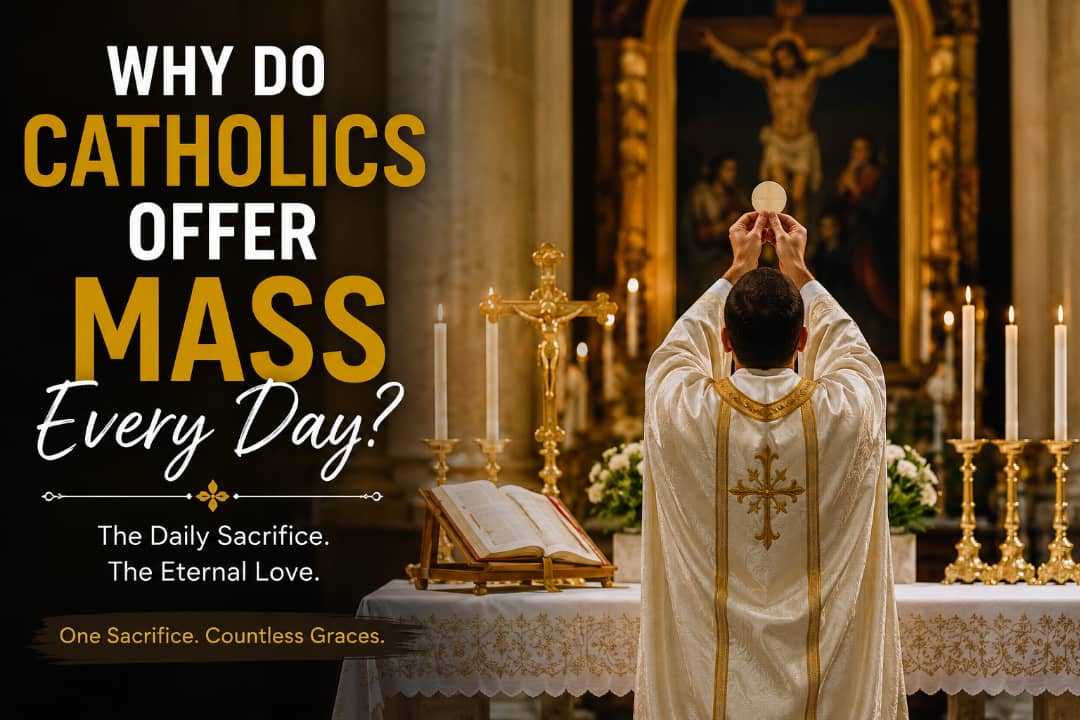
One of the questions frequently asked about Catholic worship is: Why do Catholics celebrate Mass every day? If Jesus died once for all on Calvary, why is the Holy Mass offered daily around the world? To many observers, it can appear repetitive or unnecessary. Yet, for Catholics, the daily celebration of the Mass is neither a repetition of Christ’s sacrifice nor merely a religious gathering. It is the very heart of the Church’s life and the highest act of worship offered to God.
From the earliest centuries of Christianity, believers understood that worship was not reserved for Sundays alone. The third-century theologian Origen observed that Christians “partake of the flesh of the Lamb every day,” reflecting a tradition that viewed every day as an opportunity to encounter Christ in the Eucharist. This ancient witness reveals that daily Mass is not a medieval invention but a practice rooted in the faith of the early Church.
At the center of Catholic teaching is the conviction that the Mass is first and foremost a sacrifice. While it is also a sacred meal and an assembly of believers, these aspects flow from its deeper identity as the sacramental re-presentation of Christ’s sacrifice on the Cross. Throughout history, every civilization has offered sacrifices to acknowledge God’s sovereignty, express gratitude, seek His help, and make atonement for sin. Yet every human sacrifice is limited because human beings themselves are finite.
Only one sacrifice is worthy of the infinite majesty of God: the sacrifice of Jesus Christ. As both true God and true man, Christ alone could offer the perfect act of obedience and love on behalf of humanity. On Calvary, He offered Himself once and for all, accomplishing the redemption of the world. His sacrifice is complete, perfect, and never needs to be repeated.
The Catholic Church teaches that the Mass does not repeat Christ’s sacrifice. Rather, it makes the one sacrifice of Calvary sacramentally present across time. During the Eucharistic celebration, Christ Himself is both Priest and Victim. The ordained priest acts in persona Christi—in the person of Christ—offering to the Father the same spotless sacrifice that was offered on the Cross. What changes is not the sacrifice itself but the manner in which believers participate in it.
Because Christ’s sacrifice remains eternally effective, the Church celebrates the Mass every day so that its saving power may continually be applied to the needs of the world. Every Mass becomes an opportunity to adore God, thank Him for His countless blessings, pray for the living and the dead, seek forgiveness for sins, and intercede for peace, healing, and salvation. In every corner of the globe, the Church fulfills Christ’s command at the Last Supper: “Do this in remembrance of me” (Luke 22:19).
The daily offering of the Mass also fulfills the remarkable prophecy of Malachi, who foretold that from the rising of the sun to its setting, a pure offering would be presented among all nations. Catholics see this prophecy realized in the Holy Eucharist, where the spotless Lamb of God is offered sacramentally in every place throughout the world.
Attending daily Mass is not an obligation for most Catholics, yet the Church has always encouraged it because of the immense spiritual benefits it brings. The faithful unite themselves to Christ’s perfect offering, receive abundant grace, deepen their love for God, and strengthen their resolve to live holy lives. Even when Holy Communion is not received, devout participation in the Mass remains a profound encounter with the mystery of redemption.
The saints consistently praised the incomparable value of the Holy Mass. St. Louis de Montfort wrote that the Mass gives boundless honor to the Holy Trinity because it presents the merits of Christ’s Passion, obedience, and Precious Blood to the Father. He also noted that all heaven rejoices whenever the faithful participate in this sacred mystery, for through it the fruits of Christ’s Passion continue to sanctify souls.
Traditional Catholic spirituality likewise teaches that every Mass heard with devotion obtains countless graces. It strengthens the soul against temptation, helps cleanse venial sins, obtains divine assistance in daily life, and prepares believers for a holy death. The Mass becomes a powerful source of consolation, mercy, and hope because it places Christians at the foot of the Cross, where God’s love for humanity is most perfectly revealed.
Priests are strongly encouraged to celebrate Mass every day, even though Church law does not strictly require it. Their daily offering of the Eucharist is a profound expression of their vocation to intercede for God’s people and to make Christ present in the world. Likewise, the faithful who cannot attend daily Mass are encouraged to unite their morning prayers with the countless Masses being celebrated across the globe each day.
Ultimately, the Church celebrates Mass every day because there is no greater act of worship on earth. Every celebration draws the faithful into the mystery of Christ’s redeeming sacrifice, pours out grace upon the Church and the world, and gives perfect glory to God. Far from being a routine ritual, the Holy Mass is heaven touching earth—a daily invitation to stand at Calvary, encounter the risen Lord, and share in the inexhaustible fruits of His saving love.
About the Author