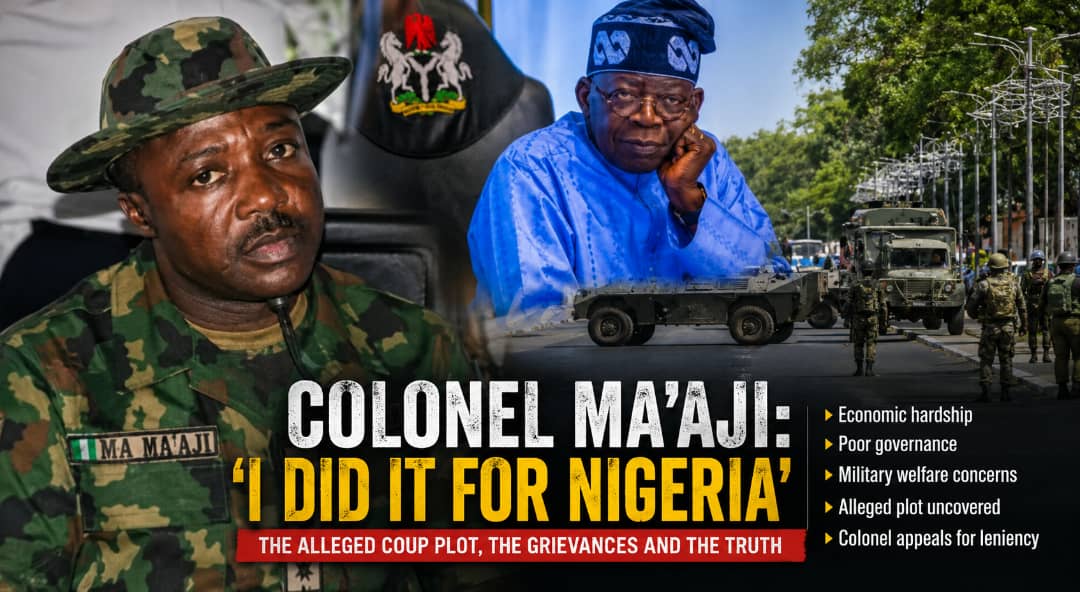
Nigeria is becoming a banana republic” — Army officer explains the grievances he says pushed him toward an alleged plot against the Tinubu government
ABUJA — Nigerian Army Colonel Mohammed Ma’aji has offered a striking account of the circumstances surrounding an alleged plot to overthrow President Bola Ahmed Tinubu’s government, insisting that his actions were motivated not by personal ambition, but by what he described as patriotism and deep concern over Nigeria’s worsening condition.
According to Premium Times, Ma’aji told the panel investigating the alleged plot that economic hardship, poor governance, declining national welfare and the difficulties confronting military personnel were among the factors that influenced his actions.
The colonel reportedly said the concerns had developed over time, driven by his belief that Nigeria was gradually heading toward a dangerous point of collapse.
‘I WAS WORRIED ABOUT THE COUNTRY’
Ma’aji reportedly presented his actions as the product of frustration rather than a quest for power.
He pointed to the increasing cost of living and the difficulty of providing for his five children on his salary as examples of the broader economic pressures confronting ordinary Nigerians.
Having attended Army Day Secondary School, he also questioned how many Nigerian families could now afford similar educational opportunities for their children, blaming what he described as years of poor governance.
For Ma’aji, the issue went beyond his personal circumstances.
He argued that the struggles facing military personnel were particularly troubling because soldiers were expected to defend the country under extremely difficult conditions.
WOUNDED SOLDIERS AND MILITARY WELFARE
One of his major concerns, according to the report, was the welfare of soldiers wounded during combat operations.
Ma’aji alleged that some injured soldiers receiving treatment at the 44 Nigerian Army Reference Hospital in Kaduna were not receiving adequate care.
He reportedly viewed the situation as evidence of deeper institutional problems within the armed forces.
For an officer involved in military operations, he said such conditions were difficult to ignore.
His concerns, he maintained, contributed to his conviction that something needed to change urgently.
‘NIGERIA IS BECOMING A BANANA REPUBLIC’
Ma’aji reportedly described Nigeria as becoming a “banana republic”, warning that the country was moving in a dangerous direction.
He said his ultimate desire was to see a prosperous Nigeria—one capable of providing dignity, security and opportunity for its citizens.
However, rather than pursuing change through conventional political or institutional channels, the allegations against him placed him at the centre of a purported military plot.
Ma’aji reportedly said the alleged operation was still at the mobilisation stage when he was arrested.
According to his account, the plan involved recruiting military officers and soldiers who shared similar concerns. He said the group had not yet been fully assembled and that additional meetings were expected.
He also denied that a specific date had been chosen to execute the alleged operation.
DENIAL OF FOREIGN INVOLVEMENT
Ma’aji reportedly denied foreign involvement in the alleged plan.
He said he personally financed a significant portion of the operation, while Timipre Silva was alleged to have contributed approximately ₦400 million.
He also denied reaching out to some senior military officers who had reportedly been linked to the allegations.
According to his account, the movement was fuelled partly by dissatisfaction among military personnel and his own frustrations over unsuccessful attempts to secure promotion.
A CALL FOR REFORMS WITHIN THE MILITARY
Beyond his defence of his alleged actions, Ma’aji reportedly proposed several measures he believes could address some of the grievances within the military.
Among his recommendations were improved remuneration and welfare packages for military personnel, better pension benefits, expanded educational opportunities and stronger mechanisms for addressing corruption.
He also called for a formal channel through which officers and soldiers could communicate their grievances to the Chief of Army Staff, Lieutenant General Waidi Shaibu, without fear of victimisation.
His argument, essentially, was that soldiers should have a safe and institutionalised way of expressing legitimate concerns before frustration reaches a dangerous level.
FUEL SUBSIDY ALSO A POINT OF CONTENTION
Ma’aji reportedly criticised the removal of the fuel subsidy, arguing that the policy should have been phased out gradually rather than removed abruptly.
His position reflects one of the wider debates surrounding Nigeria’s economic reforms, particularly the impact of subsidy removal on household income and the cost of living.
‘I HAVE RECONSIDERED MY APPROACH’
Following his arrest and subsequent appearance before the panel investigating the alleged plot, Ma’aji reportedly appealed for leniency.
He said the experience had changed his mindset and insisted that the alleged action was never intended to destabilise Nigeria.
The colonel described himself and others allegedly involved as first-time offenders, appealing to the authorities for forgiveness.
“We have no other country and no other job,” was the substance of his appeal.
He maintained that his motivation was patriotism, love for Nigeria and a desire to see the country become prosperous and worthy of the pride of its citizens.
A DISTURBING CHAPTER FOR NIGERIA
The alleged coup plot, which was uncovered in late September 2025, reportedly triggered significant developments within Nigeria’s military establishment, including the cancellation of the October 1 Independence Day parade and changes in military leadership.
The allegations also generated intense public debate over military discipline, civil-military relations, economic hardship and the growing frustration among Nigerians over governance.
Ma’aji’s account now adds another dimension to that controversy.
His explanation does not, by itself, establish the legitimacy of the alleged plot or justify any attempt to overthrow a constitutional government. But it raises difficult questions about how governments respond to legitimate grievances within institutions—and how unresolved frustration can evolve into threats to democratic stability.
For Nigeria, the bigger question remains: How can legitimate grievances be addressed early enough to prevent frustration from becoming a threat to the democratic order?
About the Author