Tinubu’s Quiet Return, Lagos Arrival and the Questions Nigerians Are Asking
Something about the return of President Bola Ahmed Tinubu from his long European vacation has left many Nigerians asking questions.
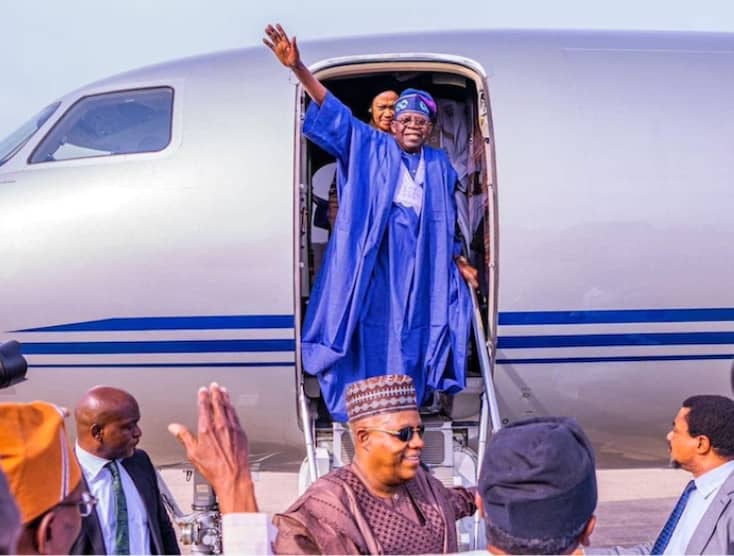
After almost four weeks away from the country, the President returned to Nigeria on Tuesday, September 29, 2026.
His aircraft landed at the Presidential Wing of the Murtala Muhammed International Airport, Lagos, at approximately 6:22 p.m. after departing Paris, France.
But it was not an ordinary presidential arrival.
Reports indicated that journalists at the airport were restricted from taking visuals of the President’s arrival. That unusual level of media control immediately revived memories of previous periods in Nigeria when presidential health questions became subjects of intense public speculation.
For some Nigerians, the circumstances surrounding the return have therefore raised an uncomfortable question:
Are we witnessing the same communication tactics that Nigerians saw during the late President Umaru Musa Yar’Adua’s illness?
That comparison must, however, be treated carefully. The present situation is not proof that President Tinubu is facing the same medical circumstances. In fact, shortly after his arrival, Tinubu personally spoke to journalists and dismissed concerns about his health, saying he was “healthy, sound, and ready to go.”
Yet questions about transparency remain.
Why Lagos?
Nigeria’s political capital is Abuja. The Presidency itself explained that Tinubu chose Lagos first to honour the memory of the late MKO Abiola and attend an October 1 film premiere at the Wole Soyinka National Theatre. The Presidency also said he would hold strategic meetings with political leaders and associates in Lagos before eventually returning to Abuja.
That explanation is on record.
But another political reality cannot be ignored.
The President’s prolonged absence had already generated constitutional debate, particularly over Section 145 of the 1999 Constitution and whether a written declaration had been transmitted concerning the President’s inability to discharge his functions while away.
The African Action Congress even approached the Federal High Court over the issue, arguing that the National Assembly should have taken action after the absence extended beyond 21 days. Those are allegations and legal questions that remain subject to judicial determination, not established findings of wrongdoing.
This is where the timing of the President’s return becomes politically interesting.
Did he return simply because his vacation had ended?
Was Lagos chosen because of the Independence Day programme and political engagements already announced by the Presidency?
Or did the growing constitutional debate and pressure surrounding his prolonged absence contribute to the timing?
At this point, Nigerians can ask the questions, but nobody outside those directly involved can honestly claim to know the President’s private calculations.
And then there is October 1.
Will President Tinubu’s Independence Day address be delivered live?
Or will it be pre-recorded?
That question may appear simple, but in the present atmosphere, even small details surrounding the President’s public appearances are likely to attract enormous attention.
Nigeria has been here before.
The Yar’Adua years left a lasting lesson about the dangers of secrecy surrounding the health and whereabouts of a sitting President. That history explains why Nigerians are particularly sensitive whenever information about a President’s absence, health or public appearance is tightly controlled.
The lesson should not be that every unusual presidential arrangement means there is a hidden agenda.
The lesson should be that transparency reduces speculation, while secrecy creates room for speculation to grow.
President Tinubu has returned.
He says he is healthy and ready to work.
The Presidency has explained why he returned through Lagos.
The constitutional questions raised during his absence remain part of the national conversation.
Now, Nigerians will watch what happens next.
Will the President return to Abuja as announced?
Will the October 1 Independence Day programme proceed as scheduled?
Will his address be live or recorded?
And, perhaps most importantly, will the Presidency provide Nigerians with enough information to prevent rumours from becoming the dominant source of public understanding?
For now, the questions remain.
Time, as always, will tell.
About The Author