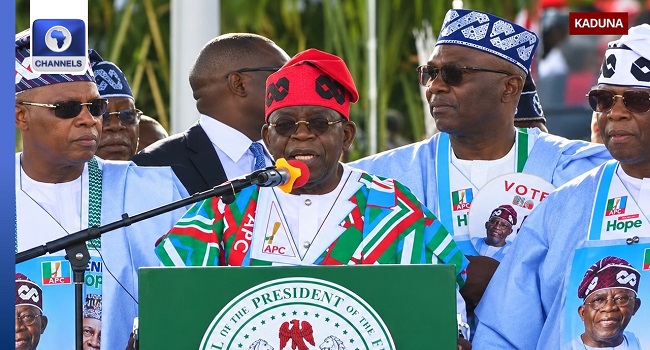
Recently, at the flag-off of the APC presidential campaign in Kaduna, President Bola Ahmed Tinubu made a rather disturbing statement. He said, “I hear my opponents talking about hunger and poverty. Who created it? They did.”
I wondered whether the President actually appreciated the extent of hunger and poverty in the country, or whether he was simply playing politics with the suffering of Nigerians.
His statement immediately reminded me of the concerns raised by John Cardinal Onaiyekan during an interview on Arise TV in July 2026. Speaking after a meeting between the Catholic Bishops and the President, the Cardinal expressed concern that those surrounding Tinubu were painting a rosy picture of Nigeria rather than telling him the truth about the suffering of ordinary citizens.
According to Cardinal Onaiyekan, when the bishops told the President that the nation was bleeding and that the economy was not helping the poor, he disagreed with their assessment.
This raises serious questions about the President’s understanding of the country he governs. How can a President be so optimistic about an economy when millions of citizens are struggling to feed themselves? And if his advisers are shielding him from the truth, does he not have a responsibility to find out for himself?
The figures are disturbing. In June 2026, the International Monetary Fund reported that poverty had reached 63 per cent of Nigeria’s population, while an estimated 27 million Nigerians faced food insecurity in late 2025. These are not figures manufactured by the opposition. They are findings from an international institution that has also acknowledged some improvements in Nigeria’s economy.
Yet, at Kaduna, the President found it convenient to blame his opponents for the hunger and poverty Nigerians are experiencing. But one must ask: who exactly are these opponents? The APC has controlled the Federal Government since 2015, and Tinubu himself was instrumental in bringing the party to power. At what point does an administration stop blaming the past and begin taking responsibility for the present?
Unfortunately, this is not the first time the President’s public statements have raised questions about his grasp of the facts.
In his October 2024 Independence Day address, Tinubu claimed that Nigeria had attracted more than $30 billion in foreign direct investment within the preceding year. However, Africa Check examined the National Bureau of Statistics’ figures and found that actual foreign direct investment between April 2023 and March 2024 amounted to approximately $449 million. The Minister of Industry, Trade and Investment had earlier explained that the much larger figure represented investment commitments. But surely, there is an enormous difference between investments promised and investments actually received!
In the same address, the President claimed that his administration had cleared over ₦30 trillion in Ways and Means debt. Again, Africa Check established that the debt had been converted into longer-term obligations, not paid off. Restructuring a debt is not the same as settling it.
More recently, in his October 2026 Independence Day address, Tinubu claimed that salaries and pensions had been paid on time and in full since 2023. Yet Africa Check found documented delays in federal salary payments during 2026, which contradicted that sweeping assertion.
To be fair, some economic indicators have improved. GDP growth has strengthened, foreign reserves have increased, and reported inflation has moderated. These developments deserve acknowledgement. But falling inflation does not automatically mean falling prices. According to the National Bureau of Statistics, food inflation was still 19.59 per cent in September 2026, so the prices of essential food items remained substantially higher than a year earlier.
And this is precisely my concern. A government cannot keep celebrating statistical achievements while dismissing the lived experiences of its citizens. Economic growth is important, but what meaning does it have for a family that can no longer afford three decent meals? What comfort does an increase in foreign reserves bring to a pensioner who cannot afford medication?
I am not suggesting that Tinubu created every problem facing Nigeria. Certainly not! Many of these challenges predate his administration. But leadership requires responsibility, not endless excuses. And after more than three years in office, Nigerians are entitled to ask what concrete improvements the President’s policies have brought to their daily lives.
A President may not know everything happening in every corner of the country. That is why he has ministers, advisers, intelligence agencies and other institutions. But he must demonstrate the capacity to distinguish honest assessments from political praise, acknowledge suffering without becoming defensive, and respond with policies that ordinary people can feel.
As we approach the 2027 elections, the question should go beyond political parties, campaign promises and carefully choreographed rallies. We must examine competence, accountability, truthfulness and the actual consequences of government policies.
If the President is genuinely unaware of the extent of suffering in Nigeria, that is deeply troubling. If he is aware but prefers to dismiss legitimate complaints as opposition propaganda, that is equally troubling.
Leadership is not about repeatedly telling hungry people that prosperity is coming. It is about ensuring that prosperity becomes more than a campaign slogan.
And so, having considered the President’s statements alongside the realities facing millions of Nigerians, I ask one final question: should this man lead us come 2027? I leave this to your conscience, if you still have one.
© Oselumhense Anetor, 2026
#fadakaymedia
Feel free to SHARE!
About The Author