Anxiety rarely announces itself politely. It shows up as a tight chest before an exam, a spiral of “what ifs” before a job interview, a 2 a.m. wake-up with your mind already running through worst-case scenarios. If you’ve searched for “Catholic prayers for anxiety,” you’re probably not looking for a magic formula; you’re looking for something real to hold onto. Here’s a place to start.
Start with permission
Before any prayer, give yourself permission to come to God exactly as anxious as you are. St. Paul didn’t write “do not be anxious” as a command to suppress feeling; he wrote it inside an instruction to bring the anxiety to God: “Have no anxiety at all, but in everything, by prayer and petition, with thanksgiving, make your requests known to God” (Philippians 4:6). The peace that follows in the next verse isn’t something you manufacture; it’s described as something that “will guard your hearts and minds” — a gift, not a technique.
A short breath-prayer for the moment anxiety spikes
When your chest is tight and your thoughts are racing, long prayers are hard to access. Try this instead, timed to your breathing: breathe in slowly while thinking “Jesus, I trust…” and breathe out slowly while thinking “…in you.” Repeat for two minutes. This should not be taken as a replacement for deeper prayer. It’s a foothold to get you through the acute moment so you can access deeper prayer afterward.
The Surrender Novena, in small doses
The Surrender Novena is a specific, well-known 9-day prayer dictated by Jesus to the Italian priest Fr. Dolindo Ruotolo. Many Catholics turn to the Surrender Novena (“O Jesus, I surrender myself to you, take care of everything”) during anxious seasons. You don’t need to complete the full nine-day devotion perfectly; even praying that single line whenever a worry surfaces throughout your day can interrupt the spiral before it builds (Click HERE to find out all about the Surrender Novena).
Bring your body into it
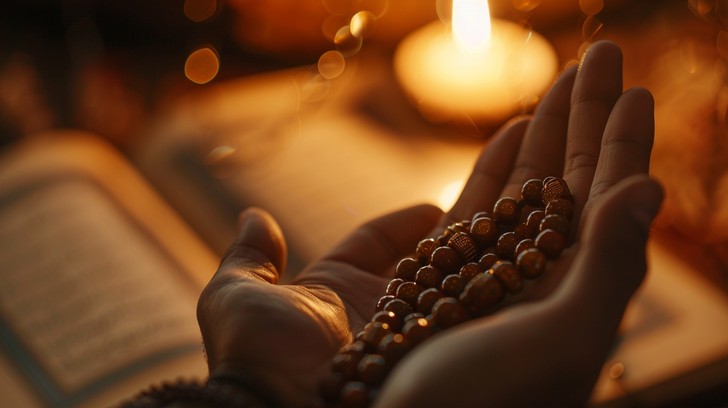
The Rosary is so effective against anxiety because it’s partly physical; the beads under your fingers give your nervous system something concrete to hold while your mind repeats familiar words. If sitting still to pray makes anxiety worse, try praying while walking, or holding a rosary in your pocket during the day and simply moving a bead every so often as a physical reminder that you’re not carrying this alone.
Know the difference between spiritual practice and professional help
Prayer is not a substitute for treatment when anxiety is persistent, physically disruptive, or affecting your ability to function day to day. The Church has never taught that faith replaces medicine. St. Luke, the patron saint of physicians, was himself a doctor. If your anxiety has been constant for weeks, please also speak with a doctor or a counsellor. Praying for peace and seeking treatment are not in competition with each other.
If today feels like a storm you can’t see the end of, our earlier reflection on finding peace in the storm might be a good companion read alongside this one.
A note on this topic: If anxiety has ever brought thoughts of harming yourself, please tell someone today — a trusted priest, a family member, or a mental health professional. That step is itself an act of courage, not weakness.
About the Author