Recently, I sat with a group of friends discussing business when our conversation suddenly took a serious turn: Is there ever a justified reason for suicide?
One of the young men narrated the story of a 27-year-old businessman who was reportedly involved in a legitimate business but suffered a devastating loss of more than ₦500 million. Overwhelmed by frustration, he eventually took his own life.
According to my friend, such a suicide was understandable because the financial loss was enormous.
But I could not help wondering: Can the magnitude of a person’s loss ever make death the rightful answer?
From a faith perspective, the answer must be no.
Life is not merely an economic asset that we own and dispose of when circumstances become unbearable.
Life is a gift from God, and its ultimate value cannot be measured in naira, property, business success or social status.
The Bible reminds us that there is a season for everything under heaven. There are seasons of abundance and seasons of scarcity; seasons of laughter and seasons of tears. Faith does not promise that believers will never experience crushing losses. Rather, it teaches us that suffering does not have the final word.
Job lost his wealth, his children and his sense of security, yet his story did not end at his darkest moment. Elijah, overwhelmed and exhausted, once prayed that he might die. God did not condemn him for his despair. Instead, God provided rest, food and renewed strength before sending him forward.
That is a powerful lesson: sometimes what a broken person needs first is not condemnation, but care.
This is why we must be deeply sympathetic to people who die by suicide and to the families they leave behind. We should never romanticise suicide, but neither should we casually condemn those who were overwhelmed by suffering. Only God fully knows the battles taking place within a person’s heart.
At the same time, faith calls us to reject the idea that financial disaster can justify taking one’s life.
₦500 million can be lost. A business can collapse. A reputation can be damaged. A career can end. Yet none of these things is greater than the God who gives life and the possibility of another beginning.A closed business can reopen. A lost fortune can be rebuilt. A broken reputation can heal.
But a life cannot be restarted by human hands.
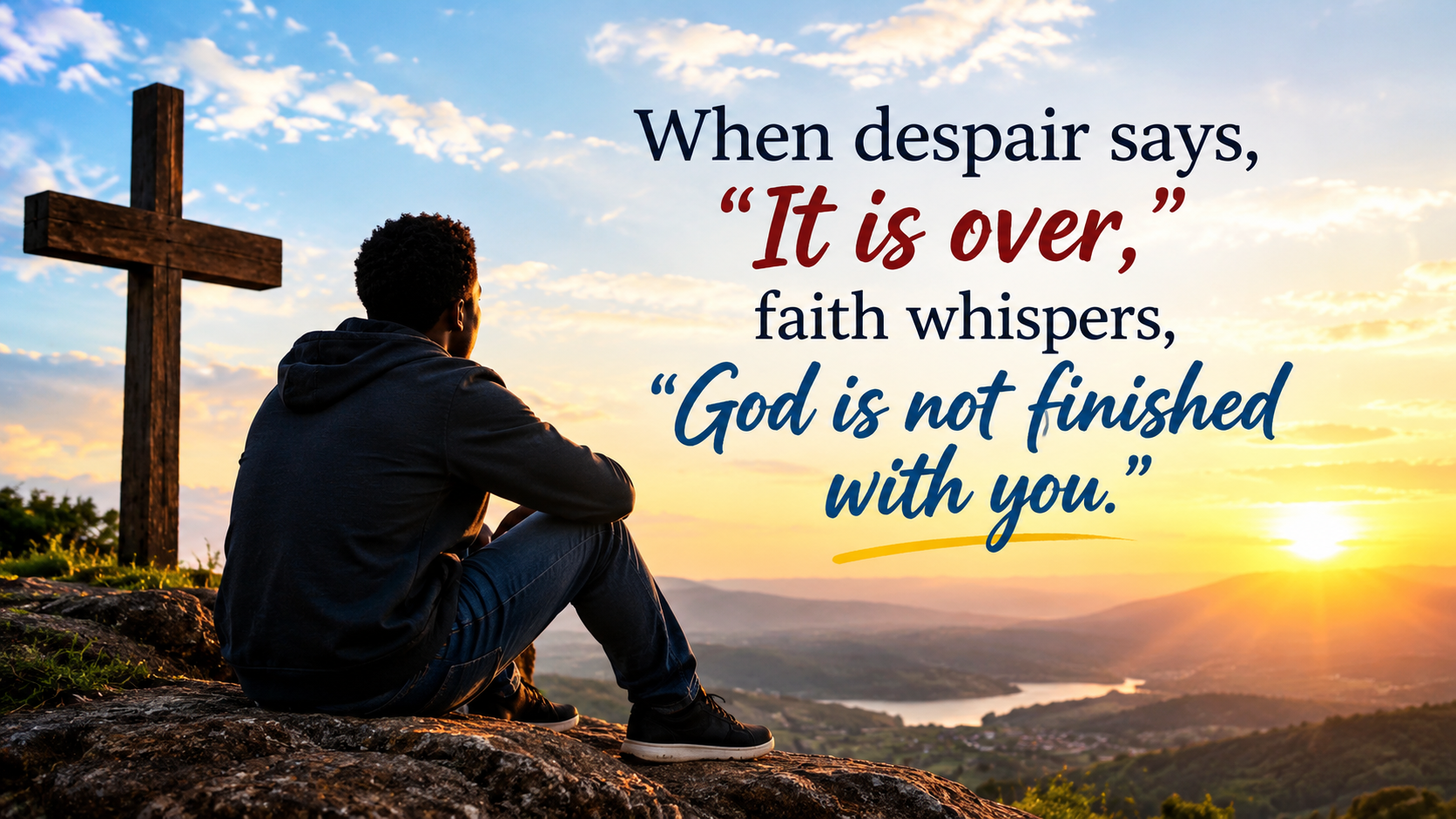
When despair whispers, “There is no way out,” faith answers, “God can make a way where you cannot yet see one.”
The Christian response to suicidal despair should therefore be neither shame nor silence. It should be prayer, presence, professional help, community and practical support. Faith and professional mental-health care do not have to compete; both can be part of the lifeline.
If someone is drowning, we do not debate whether the water is deep enough to justify saving them. We reach for them.
There may be moments when life feels unbearably heavy, but no moment of darkness should be allowed to make a permanent decision on behalf of an entire lifetime.Your loss is not your identity. Your failure is not your final chapter. And your darkest night is not proof that God has abandoned you.
Sometimes, the miracle is simply this: you survived today.
And if you can survive today, there remains the possibility of a tomorrow you have not yet seen.
Lord Jesus, hold close those who feel overwhelmed by despair. Give them strength to endure today, courage to seek help, compassionate people to support them, and hope to believe that tomorrow can still bring healing. Amen.
About The Author