Nigeria’s political economy over the past three and a half years cannot be judged fairly through slogans, party loyalty or nostalgia. It requires a sober assessment of where the country came from, what the present administration inherited, what it has changed, what those changes have cost citizens, and whether the emerging economic structure can ultimately deliver broad-based prosperity.
President Bola Ahmed Tinubu inherited an economy already carrying serious structural weaknesses. Under Muhammadu Buhari, Nigeria experienced two recessions, persistent inflation, rising public debt and weak average growth. The World Bank records that GDP growth fell from 6.3% in 2014 to 2.7% in 2015 and contracted by 1.6% in 2016.
But it would also be misleading to pretend that the Buhari administration inherited a healthy economy from Goodluck Jonathan. Jonathan benefited from a period of relatively strong oil prices and economic expansion, while Nigeria still failed to sufficiently diversify its productive base or convert oil wealth into enough quality jobs and human-capital development. The World Bank noted that Nigeria’s economy had averaged strong growth in the preceding decade, but much of that growth did not translate into sufficient formal employment.
That is the central lesson: Nigeria’s economic problem is bigger than any single president. It is a structural problem that successive governments have managed differently, but have not fundamentally solved.
TINUBU: NECESSARY REFORM OR EXCESSIVE SHOCK?
The Tinubu administration deserves recognition for confronting some distortions that previous governments repeatedly postponed.
Fuel subsidies were removed. The foreign-exchange regime was substantially liberalised. Monetary policy was tightened, while fiscal and tax reforms have been pursued. These policies have helped improve government finances, attract investment and strengthen external buffers. The World Bank says Nigeria’s post-2023 macroeconomic reforms have helped stabilise the economy, while GDP growth reached 3.89% year-on-year in the first quarter of 2026.
But macroeconomic stabilisation is not the same thing as improved living standards.
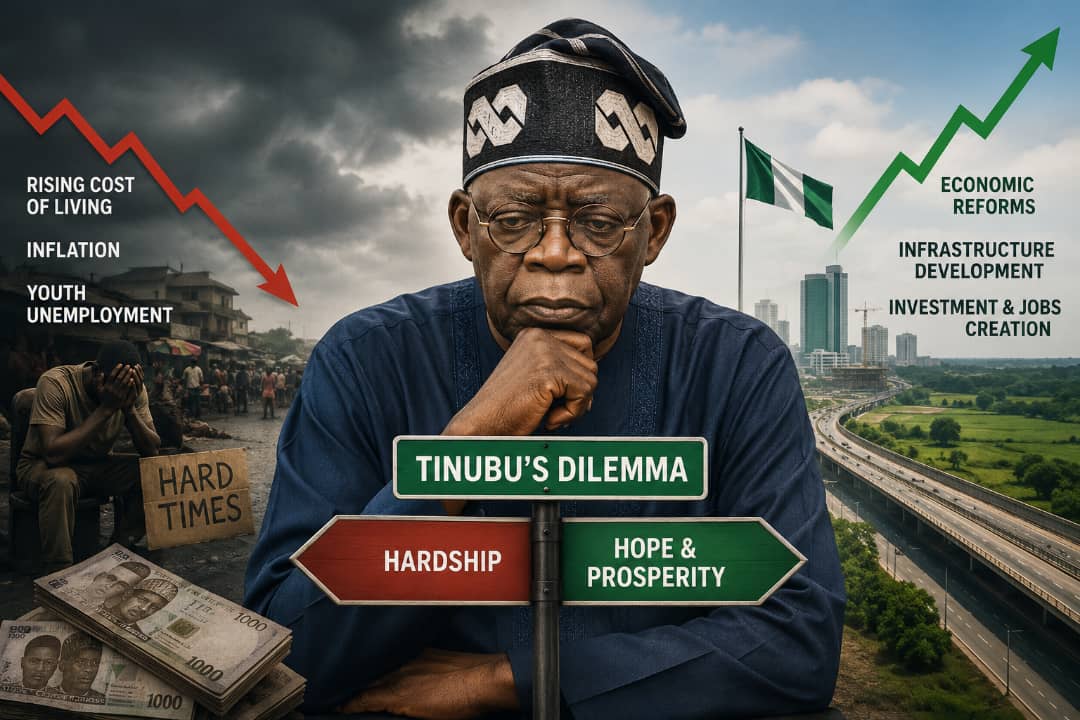
For millions of Nigerians, the immediate experience has been the opposite: higher food prices, expensive transport, reduced purchasing power, high interest rates and declining real incomes. Reuters reported in August 2026 that the reforms had improved investor confidence and market indicators while the cost-of-living crisis remained severe for ordinary households.
This creates the fundamental political-economic dilemma of the Tinubu years:
Can an economy be declared healthier when the average citizen feels poorer?
The answer must be nuanced. A country can simultaneously experience improving macroeconomic fundamentals and worsening household welfare. The challenge is therefore not simply to stabilise the economy, but to ensure that stabilisation translates into jobs, affordable food, productive investment and higher real incomes.
WHAT GEJ DID BETTER — AND WHAT HE DIDN’T
The Goodluck Jonathan era benefited from stronger oil prices and comparatively favourable external conditions. IMF data show real GDP growth of 8.0% in 2010, 7.4% in 2011, 6.6% in 2012 and 7.3% in 2014, with inflation considerably lower than today’s recent peaks.
Jonathan’s administration also pursued reforms in power, agriculture, banking and infrastructure, although implementation was uneven. The broader economic environment was substantially more favourable than the one Buhari inherited.
But nostalgia should not become economic analysis.
Jonathan’s Nigeria remained heavily dependent on oil revenues, struggled with corruption and institutional weaknesses, and failed to build a sufficiently diversified productive economy. The oil-price collapse exposed those vulnerabilities dramatically. By 2015, the economy was already entering a difficult period as oil prices fell and government revenues deteriorated. The World Bank described the incoming Buhari government as facing a severely weakened economy amid collapsing oil revenues and major structural challenges.
BUHARI: STABILITY WITHOUT ENOUGH GROWTH
Buhari’s administration deserves credit for major infrastructure investments and some important institutional and legislative reforms. But economically, the record was constrained by low growth, high inflation, rising debt and two recessions.
By the end of Buhari’s tenure, BudgIT estimated that public debt had risen sharply relative to GDP, while inflation stood at about 22.4% and poverty had become extraordinarily widespread.
COVID-19, the oil-price collapse, insecurity and the Russia-Ukraine war undeniably complicated Buhari’s economic management. Nevertheless, the administration also made policy choices that contributed to economic distortions, including restrictions and interventions that often substituted administrative controls for deeper structural reform.
The lesson from Buhari is therefore not simply that government spending is bad. It is that spending without sufficient productivity, revenue mobilisation and private-sector expansion cannot create sustainable prosperity.
SO WHERE SHOULD NIGERIA GO FROM HERE?
The best option is neither a return to the old subsidy regime nor an unquestioning continuation of painful adjustment.
Nigeria needs a third way: disciplined macroeconomic reform combined with aggressive social and productive investment.
Five priorities stand out:
1. Protect the vulnerable without recreating wasteful universal subsidies.
Government should use targeted social protection, transport support, food interventions and credible cash-transfer systems to cushion households genuinely affected by reforms.
2. Move from an oil economy to a production economy.
Agriculture, manufacturing, solid minerals, technology, construction and renewable energy must become engines of employment and exports—not merely political slogans.
3. Make food security a national economic strategy.
Cheap food cannot come from speeches. It requires security for farmers, irrigation, storage, rural roads, credit, mechanisation, processing and functioning markets.
4. Reduce the cost of doing business.
Nigeria cannot tax its way into prosperity while businesses face expensive electricity, multiple levies, unreliable infrastructure, insecurity and difficult access to credit. The private sector must be treated as a partner in development.
5. Make government more accountable for outcomes.
Citizens should judge administrations by measurable improvements in income, jobs, electricity, security, education, healthcare, infrastructure and purchasing power—not by the volume of political propaganda surrounding them.
The current administration’s reforms have produced signs of macroeconomic stabilisation. Inflation has fallen substantially from its 2024 peak, foreign reserves have strengthened and growth has become more resilient. But high interest rates and persistent household hardship show that the transition remains incomplete.
THE REAL POLITICAL-ECONOMIC QUESTION
The debate should therefore move beyond “Jonathan versus Buhari”, or “Buhari versus Tinubu.”
The more important question is:
Which economic model can give Nigerians both stability and prosperity?
Jonathan’s period demonstrates the danger of confusing oil-driven growth with structural transformation. Buhari demonstrates the consequences of weak growth, excessive intervention and inadequate diversification. Tinubu’s first three and a half years demonstrate that correcting deep distortions can be necessary—but that reform without adequate protection for households can impose an enormous political and social price.
Nigeria now needs the courage to complete the difficult reforms while correcting their social consequences.
The objective should not be to make Nigeria attractive to investors alone. It must become a country where investment creates productive jobs, productivity raises wages, wages improve living standards and economic growth expands opportunity for ordinary citizens.
That is the political economy Nigeria needs: not merely a stronger balance sheet for government, but a stronger economic life for the Nigerian people.
About the Author