A Traditional Catholic Teaching on Transubstantiation
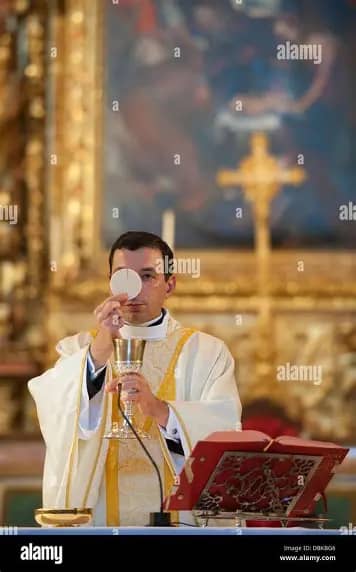
The Eucharist is the greatest treasure of the Catholic Church because it is not merely a sacred symbol or a memorial meal. It is Jesus Christ Himself. At the heart of Catholic worship stands the profound truth that, at every valid celebration of the Holy Sacrifice of the Mass, the bread and wine become the true Body, Blood, Soul, and Divinity of Our Lord Jesus Christ. This mystery is known as the Real Presence, and the change by which it occurs is called Transubstantiation.
For over two thousand years, the Catholic Church has faithfully preserved this teaching, handed down by Christ, proclaimed by the Apostles, defended by the Church Fathers, and safeguarded by the Church’s Magisterium.
What Is the Real Presence?
The Catholic Church teaches that during the Consecration at Mass, when a validly ordained priest repeats the words of Christ:
“This is My Body… This is the chalice of My Blood…” (Matthew 26:26–28),
the substance of the bread and wine is completely changed into the Body and Blood of Jesus Christ. Although the appearances of bread and wine remain the same, what truly exists is Christ Himself.
This miraculous change is called Transubstantiation.
The Catechism of the Catholic Church teaches:
“In the most blessed sacrament of the Eucharist the body and blood, together with the soul and divinity, of our Lord Jesus Christ and, therefore, the whole Christ is truly, really, and substantially contained.” (CCC 1374)
Thus, every Holy Communion is a personal encounter with the living Christ.
Christ Himself Taught the Real Presence
The doctrine did not originate with the medieval Church. It comes directly from Jesus.
The Bread of Life Discourse (John 6:51–58)
Jesus declared:
“I am the living bread which came down from heaven… The bread which I shall give for the life of the world is my flesh.”
When His listeners questioned Him, Jesus did not soften His words. Instead, He became even more emphatic:
“Unless you eat the flesh of the Son of Man and drink His blood, you have no life in you. Whoever eats My flesh and drinks My blood has eternal life… For My flesh is true food and My blood is true drink.”
Many disciples found this teaching difficult.
“After this many of His disciples drew back and no longer walked with Him.” (John 6:66)
Rather than explaining His words away as symbolic, Jesus allowed them to leave. He even turned to the Twelve and asked:
“Will you also go away?” (John 6:67)
This demonstrates that Christ intended His words literally.
The Institution of the Eucharist
At the Last Supper, Jesus fulfilled what He had promised.
Matthew 26:26–28 records:
“Take, eat; this is My body… Drink from it, all of you; for this is My blood of the covenant.”
Jesus did not say, “This represents My body.”
He declared:
“This is My Body.”
The Church has always understood these words literally.
St. Paul’s Witness
The Apostle Paul warned Christians not to receive Holy Communion carelessly.
In 1 Corinthians 11:27–29 he teaches:
“Whoever eats the bread or drinks the cup of the Lord in an unworthy manner will be guilty of the body and blood of the Lord.”
Such a warning would make little sense if the Eucharist were merely symbolic. Paul teaches that receiving unworthily is a grave offense because the Eucharist truly is Christ Himself.
The Witness of the Early Church
The earliest Christians believed exactly what Catholics believe today.
Around AD 107, St. Ignatius of Antioch wrote:
“They abstain from the Eucharist because they do not confess that the Eucharist is the flesh of our Savior Jesus Christ.”
Around AD 150, St. Justin Martyr explained:
“We do not receive these as common bread or common drink, but… as the flesh and blood of Jesus who became incarnate.”
These testimonies come long before later theological debates and show that belief in the Real Presence belongs to apostolic Christianity.
The Holy Sacrifice of the Mass
In the Traditional Catholic understanding, the Mass is not a new sacrifice.
Rather, it is the sacramental re-presentation of the one perfect sacrifice of Christ on Calvary.
Hebrews teaches that Christ is our eternal High Priest who continually intercedes for us before the Father (Hebrews 4:14–16).
Every Mass makes present that one eternal sacrifice in an unbloody manner.
This is why Catholics kneel before the Blessed Sacrament.
This is why we genuflect before the tabernacle.
This is why the Eucharist is adored.
We worship Christ because Christ is truly present.
The Eucharist as the Fulfillment of the Old Testament
The New Passover
In the Old Covenant, every family sacrificed a spotless lamb and then ate it (Exodus 12).
John the Baptist proclaimed:
“Behold, the Lamb of God who takes away the sin of the world.” (John 1:29)
The Book of Revelation presents Christ as the Lamb standing as though slain (Revelation 5:6).
As Israel consumed the Passover lamb, Christians now receive Christ, the true Passover Lamb.
The New Manna
God fed Israel with manna during their journey through the wilderness.
Jesus declared:
“I am the Bread of Life… I am the living bread that came down from heaven.” (John 6:48–51)
Unlike the manna that sustained earthly life, the Eucharist gives eternal life.
The Pure Offering
The prophet Malachi foretold:
“From the rising of the sun to its setting My name shall be great among the nations, and in every place a pure offering shall be made to My name.” (Malachi 1:11)
Catholics understand this prophecy to be fulfilled in the Holy Sacrifice of the Mass, celebrated throughout the world every day.
The Eucharist and the Priesthood
The Eucharist also fulfills God’s promise that His people would become a priestly nation.
God declared to Israel:
“You shall be to Me a kingdom of priests.” (Exodus 19:5–6)
The Church teaches the common priesthood of all believers, who unite themselves spiritually to Christ’s sacrifice (CCC 897–903).
Alongside this stands the ministerial priesthood, through which ordained priests act in persona Christi—in the Person of Christ—to consecrate the Eucharist (CCC 1536–1600).
Without a valid priesthood, there can be no valid Eucharistic consecration.
The Eucharist Builds the Church
St. Paul teaches:
“Because there is one bread, we who are many are one body.” (1 Corinthians 10:16–17)
The Eucharist is therefore both communion with Christ and communion with His Church.
As St. Augustine beautifully expressed:
“Become what you receive.”
Receiving Christ transforms believers into His Mystical Body.
Receiving Holy Communion Worthily
Because the Eucharist is truly Christ Himself, Catholics prepare carefully before receiving Him.
Knowledge
One must understand and believe what the Church teaches concerning the Eucharist.
For this reason, Holy Communion is ordinarily reserved for Catholics who are in full communion with the Church.
State of Grace
St. Paul warns against receiving unworthily (1 Corinthians 11:27–30).
Anyone conscious of mortal sin should first receive the Sacrament of Reconciliation before approaching Holy Communion.
Venial sins, however, are forgiven through worthy reception of the Eucharist (CCC 1393).
Reverence
The faithful approach Holy Communion with profound devotion.
Traditional practices include fasting before Mass, genuflecting before the Blessed Sacrament, receiving with recollection and humility, and, where permitted or customary, receiving on the tongue as an outward sign of reverence for Christ truly present.
Eucharistic Adoration
Since Jesus remains truly present in the consecrated Host after Mass, Catholics reserve the Blessed Sacrament in the tabernacle.
This makes Eucharistic Adoration possible.
In silent prayer before the Blessed Sacrament, believers fulfill Christ’s promise:
“I will not leave you orphans.” (John 14:18)
He remains with His Church until the end of time.
Corpus Christi
The Solemnity of the Most Holy Body and Blood of Christ (Corpus Christi) is the Church’s public profession of faith in the Real Presence.
Through Eucharistic processions, Benediction, Adoration, and solemn Masses, Catholics proclaim to the world that Jesus Christ truly dwells among His people.
It is an invitation to renew our love for the Blessed Sacrament and to ask ourselves:
- Do I truly believe Jesus is present in the Eucharist?
- Do I receive Him worthily and with reverence?
- Does Holy Communion transform my daily life?
Conclusion
The Eucharist is the source and summit of the Christian life because it is Jesus Himself.
At every Holy Mass, heaven touches earth. The one sacrifice of Calvary becomes sacramentally present. The faithful receive not ordinary bread, but the living Christ—Body, Blood, Soul, and Divinity.
This is the mystery of the Real Presence.
This is the miracle of Transubstantiation.
May we approach the altar with faith like St. Peter, who answered when many others walked away:
“Lord, to whom shall we go? You have the words of eternal life.” (John 6:68)
May every Holy Communion deepen our union with Christ, strengthen our holiness, and prepare us for the eternal banquet in the Kingdom of Heaven.
About the Author