Last night, after spending quite some time away from Nigeria’s capital, I finally had the opportunity to sit down with a few acquaintances, relax over drinks and catch up.
I thought it would be an ordinary evening.
I was wrong.
What began as casual conversation quickly turned into a heated political debate about Nigeria, 2027 and, above all, Peter Obi.
And no, the argument was not about football—even though we had just watched Arsenal tear apart a Chelsea side that had started the season with plenty of optimism.
There were five of us at the table: two Igbo men, a Kaduna man, a Bayelsa man and myself, a Tiv man from Gwer East.
I deliberately stayed neutral.
I listened.
And what I heard was more interesting than many of the political arguments we see on television and social media.
“I Regret Supporting Peter Obi”
The Kaduna gentleman opened the debate with a rather surprising confession.
He said he regretted supporting Peter Obi, although he still admired Obi personally.
His problem with Obi, he argued, was not competence.
It was not integrity.
It was not even popularity.
It was strategy.
His argument was that anyone seriously interested in becoming President of Nigeria must understand that presidential elections are won through much more than public enthusiasm.
“You need political structures,” he argued. “You need alliances. You need relationships across regions. You need people who can deliver votes outside your traditional stronghold.”
Then he made his most controversial suggestion.
He argued that Peter Obi should consider building a strategic partnership with a credible northern politician—even if that meant accepting the vice-presidential slot under a northern presidential candidate before eventually pursuing the presidency.
At first, I thought the suggestion would be dismissed.
It wasn’t.
It opened a political Pandora’s box.
When Politics Became Ethnicity
One of the Igbo participants agreed with him.
The other strongly disagreed.
Suddenly, we were no longer discussing political strategy.
We were discussing identity.
The second Igbo participant argued passionately that Peter Obi remains the ideal candidate and that the Igbo people have waited long enough for the presidency.
His argument was essentially this:
If the presidency has rotated among other parts of Nigeria, why shouldn’t the Southeast have its turn?
It was a powerful emotional argument.
But I was not completely convinced.
Not because I dislike Peter Obi.
Quite the opposite.
I personally like Peter Obi and understand why millions of Nigerians see him as a symbol of competence, accountability, prudence and a different style of leadership.
But there is a dangerous line between supporting a candidate because of his competence and supporting a candidate simply because he comes from your ethnic group.
Nigeria is bigger than ethnicity.
The presidency of Nigeria cannot permanently become a contest over whose turn it is.
The real question should be:
Who can unite enough Nigerians to win—and then govern effectively?
Is Popularity Enough?
This is where the Kaduna man’s argument deserves serious consideration.
He may not have been completely right.
But he raised a question that Peter Obi’s supporters cannot afford to ignore.
Popularity does not automatically translate into electoral victory.
Social media popularity is not the same thing as polling-unit strength.
A massive crowd at a rally is not the same thing as votes across 36 states.
A passionate support base is not the same thing as a national political coalition.
And this is where presidential politics becomes brutally mathematical.
You need numbers.
You need structures.
You need alliances.
You need competent political organisers.
You need people who understand local politics in places far removed from your traditional base.
Most importantly, you need to convince Nigerians who do not share your ethnicity, religion or regional interests that your presidency will belong to them too.
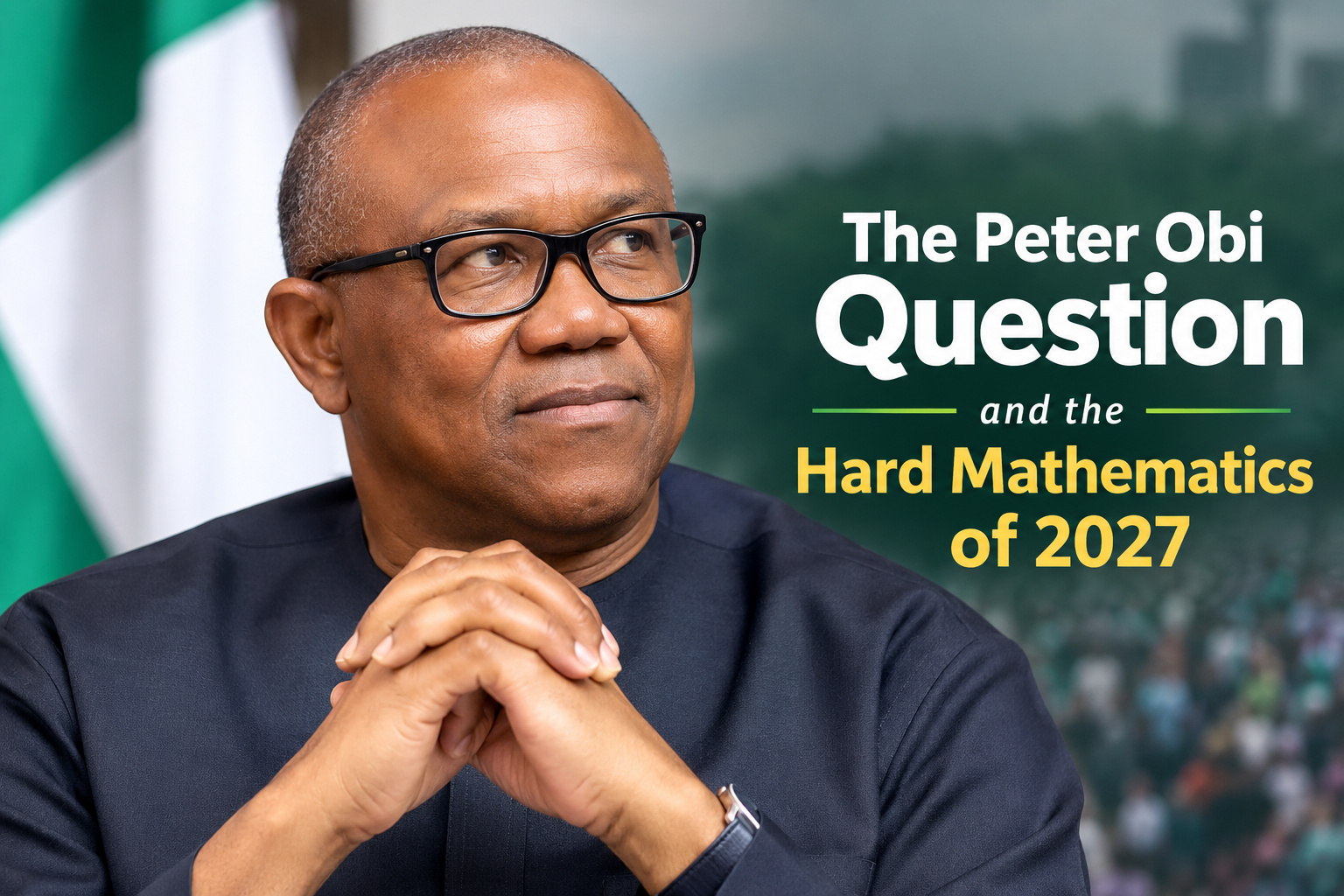
The Peter Obi Dilemma
Peter Obi has already demonstrated that he can generate extraordinary political enthusiasm.
That is not in serious doubt.
The bigger question is whether that enthusiasm can be transformed into a sufficiently broad national electoral coalition.
Can he make significant inroads into the North?
Can he deepen his presence in the Southwest?
Can he consolidate the South-South?
Can he strengthen his appeal in the Middle Belt?
Can he persuade Nigerians who admire him but are not emotionally attached to his political movement to actually vote for him?
Those are not minor questions.
They could determine the outcome of 2027.
And this is precisely where I think the conversation surrounding Peter Obi needs to mature.
We spend too much time arguing about whether he is competent.
We spend too much time fighting over ethnicity.
We spend too much time debating religion.
We spend too much time insulting one another online.
But perhaps we are avoiding the most important question:
How does Peter Obi build the coalition required to win the presidency of Nigeria?
The North Cannot Be Ignored
If Obi wants another serious presidential opportunity, he cannot afford to treat the North merely as an electoral territory to be visited during campaign season.
He needs relationships.
He needs conversations.
He needs political allies.
He needs grassroots structures.
And most importantly, he needs to convince ordinary northerners that his political vision includes them.
The same applies to every other region.
A presidential candidate cannot build a truly national movement by speaking primarily to people who already agree with him.
The real political test is convincing people who do not naturally support you.
That is where political leadership begins.
Should Obi Compromise?
This is perhaps the most uncomfortable question.
Should Peter Obi remain uncompromisingly committed to his presidential ambition?
Or should he be willing to enter a broader coalition, make difficult compromises and possibly accept a less dominant position if it creates a stronger pathway to the presidency in the future?
Some supporters would consider such a move political surrender.
Others would call it strategic maturity.
Personally, I don’t think there is an easy answer.
Politics is not a church service.
It is not a courtroom where everything must be either right or wrong.
Politics is negotiation.
Politics is coalition-building.
Politics is compromise.
And sometimes, the person who appears to concede today may be positioning himself to win tomorrow.
What Are Ordinary Nigerians Really Asking For?
At some point during the argument, I stopped thinking about Peter Obi.
I started thinking about the ordinary Nigerian.
The trader struggling with rising costs.
The graduate searching endlessly for employment.
The parent wondering how to pay school fees.
The farmer worried about insecurity.
The young Nigerian looking for a reason to believe that tomorrow can be better than today.
These people may not care about the endless political arguments on X, Facebook or WhatsApp.
They want security.
They want jobs.
They want affordable food.
They want functioning schools.
They want hospitals that work.
They want electricity.
They want roads.
They want a government they can trust.
And perhaps that is the real political lesson.
Nigerians are not necessarily looking for an ethnic messiah. They are looking for a government that works.
And Then Came the Joke
After listening to everyone argue for quite some time, someone eventually looked at me and asked what I thought.
I smiled.
After all, I was the neutral Tiv man at the table.
And before anyone starts saying the political conclusions were the result of excessive drinking, let me make one thing clear:
I drank only one Fearless throughout the entire discussion!
So, perhaps I wasn’t tipsy after all.
Perhaps I was simply listening.
And sometimes, the most revealing political conversations do not happen at political rallies.
They happen around ordinary tables.
Among ordinary Nigerians.
People who may never appear on television.
People who may never write newspaper columns.
People who simply sit down, argue, laugh, disagree and ask one fundamental question:
Where is Nigeria going?
The Real Peter Obi Question
So, after everything I heard that evening, I believe the question surrounding Peter Obi should change.
It should no longer be:
“Is Peter Obi a good candidate?”
That question has been debated endlessly.
The more difficult question is:
“Can Peter Obi build the political coalition capable of making him President of Nigeria?”
That is not an attack on Peter Obi.
It is not an endorsement of another candidate.
It is a question about political reality.
Nigeria is a country of enormous complexity—ethnic, religious, regional, economic and political.
Anyone who wants to occupy Aso Rock must somehow bring enough of those competing interests together.
That requires more than passionate supporters.
It requires strategy.
It requires structures.
It requires alliances.
It requires persuasion.
And it requires the ability to make Nigerians in every corner of the country believe:
“This presidency is also for me.”
Perhaps Peter Obi can build that coalition.
Perhaps he cannot.
But if he intends to make another serious attempt at the presidency, the work cannot begin a few months before election day.
It must begin now.
Because in Nigerian politics, you cannot build a national coalition at the ballot box.
You build it long before the ballot box.
And perhaps that is what the masses are really saying.
Nigeria does not merely need a popular candidate.
Nigeria needs a candidate capable of turning popularity into a national coalition—and turning that coalition into effective governance.
That is the conversation we should be having.
About the Author